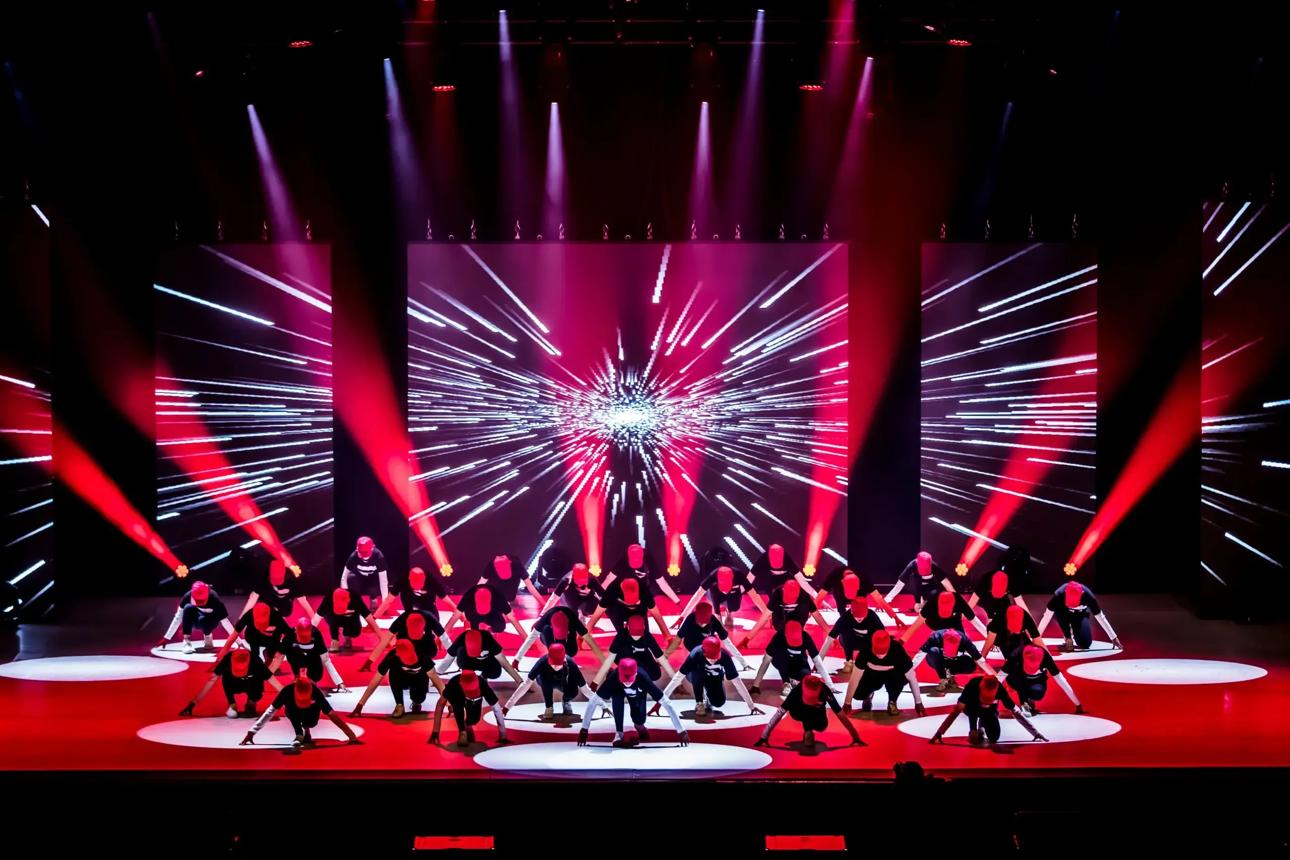
There are performances that make an audience clap, performances that make an audience stand, and then there are performances that make everyone in the room wonder whether somebody secretly pressed the fast-forward button.
Pulse Motion belongs in that last category.
With razor-sharp choreography, explosive energy and the kind of synchronization that makes a group of dancers appear to share one brain, Pulse Motion is the sort of act that can turn an America’s Got Talent stage into something much bigger than a television audition. In this creative behind-the-scenes feature, the dance crew’s journey is imagined as the kind of Golden Buzzer story AGT fans love: dramatic on stage, emotional when the music stops—and hilariously chaotic the second the cameras turn away.
And if there is one lesson Pulse Motion learns along the way, it is this: making six, eight or a dozen people move at exactly the same time is considerably easier than getting them all to agree on where they left their shoes.

When the Lights Go Down, Pulse Motion Turns Up
The imagined Pulse Motion audition begins quietly.
The dancers walk onto the stage without giving away too much. There is no need for an elaborate introduction. Their confidence does most of the talking.
Then the music starts.
One movement becomes two. Two dancers become four. Suddenly, the entire group is moving as one machine.
The choreography builds from sharp isolations into rapid formations, with dancers crossing paths so precisely that the audience begins to wonder whether there is an invisible traffic controller somewhere backstage.
That is the magic of a synchronized dance act. Viewers see the finished product, but they don’t see the thousands of tiny decisions required to make every arm, step, turn and facial expression happen at exactly the right moment.
Pulse Motion’s imagined performance would be built around that precision.
Every beat has a purpose.
Every formation has a reason.
And every dramatic pause gives the audience just enough time to think, “How on earth did they do that?”
Then the beat drops again.
The Golden Buzzer Moment
The Golden Buzzer has become one of the defining moments of America’s Got Talent. The current Season 21 format has featured 10 Golden Buzzer recipients, who earned an automatic route into the live-show stage of the competition.
For Pulse Motion, the fictional Golden Buzzer moment would arrive after the performance reaches its biggest formation.
The dancers freeze.
The music cuts.
For a second, nobody moves.
Then the audience erupts.
The judges look at one another.
One judge smiles.
Another is already halfway out of the chair.
And before Pulse Motion can figure out what is happening, the Golden Buzzer is pressed.
Gold confetti fills the stage.
The dancers scream.
Someone falls to the floor.
Someone else immediately grabs the nearest teammate.
And at least one dancer probably forgets the choreography completely because there is no choreography for “I have just been covered in several thousand pieces of gold confetti.”
That is when the television magic becomes real.
For the dancers, months or years of rehearsal have suddenly turned into one unforgettable moment.
But Backstage? Total Chaos.
The television audience sees precision.
Backstage, the story is probably much less organized.
Imagine six dancers trying to squeeze through one doorway at the same time.
Nobody wants to admit they are lost.
Everyone insists they know where they are going.
Nobody actually knows where they are going.
One dancer asks, “Is this our dressing room?”
Another says, “I think so.”
A third looks at the sign.
It isn’t.
That kind of harmless chaos is exactly what makes a dance group’s behind-the-scenes story so entertaining.
The stage performance may look almost robotic, but dancers are still human beings. They forget water bottles. They lose jackets. They discover that one shoelace has mysteriously come undone two minutes before rehearsal.
And then there is the eternal backstage mystery:
Who ate the snacks?
In every fictional dance crew, there is one person who claims they didn’t touch the snacks.
There is also one person who knows exactly what happened.
And there is always a third person who somehow has crumbs on their costume.
The Rehearsal Room Is Where the Real Work Happens
Behind every spectacular dance performance is repetition.
Lots of it.
A single eight-count sequence might be performed dozens—or even hundreds—of times until every dancer knows precisely where everyone else will be.
One dancer moves too early?
Start again.
Someone turns slightly too far?
Start again.
Formation is perfect but someone’s facial expression looks like they just remembered they left the oven on?
Start again.
The joke is that dancers can spend hours perfecting a three-minute performance and still have an argument about whether a move begins on “five” or “five-and-a-half.”
Pulse Motion’s imagined rehearsal room would be filled with music, mirrors, water bottles, stretching bands and people saying:
“Again.”
“From the top.”
“One more time.”
“Okay, seriously, last time.”
And then:
“Actually, one more.”
That final “one more” is probably the biggest lie in dance.
The Funny Side of Perfection
The more synchronized a group becomes on stage, the funnier the mistakes can be backstage.
A dancer might confidently walk into rehearsal wearing two different shoes.
Someone might arrive with their costume inside out.
Another might spend five minutes searching for a missing phone before discovering it has been in their hand the entire time.
And then there is the classic group-photo problem.
Everyone looks perfect.
Except one person.
“Let’s take another.”
Now someone else blinks.
“Again.”
The lighting changes.
“Again.”
Someone laughs.
“Again.”
Eventually the group has taken 47 photographs and decides the first one was actually fine.
That contrast—serious performers doing ridiculous things when the pressure disappears—is what makes behind-the-scenes stories so appealing to fans.
The Pressure of an AGT Stage
A talent-show stage is different from a rehearsal studio.
The floor feels different.
The lights are brighter.
The audience is enormous.
The cameras are everywhere.
And suddenly every little mistake feels enormous.
That pressure is especially intense for synchronized groups. A solo performer can sometimes recover from a missed step without anyone noticing. In a large dance crew, one person moving in the wrong direction can create a domino effect.
Yet that risk is also what makes the performance exciting.
When everyone hits the same beat, the result feels almost impossible.
Previous AGT dance groups have demonstrated just how powerful synchronization can be. Murmuration, for example, became known for intricate large-group choreography and received a Golden Buzzer from Howie Mandel during Season 18.
Pulse Motion’s imagined identity follows that same broad entertainment tradition while giving the group its own fictional personality: energetic, youthful, dramatic and just chaotic enough backstage to remind everyone that the performers aren’t machines.
The Moment Nobody Rehearsed
The best television moments are often the ones nobody planned.
Maybe a dancer starts laughing after the Golden Buzzer.
Maybe another performer is too emotional to speak.
Maybe the group tries to give a perfectly coordinated hug and accidentally turns it into a pile of dancers.
That would be the perfect Pulse Motion moment.
On stage: flawless.
Backstage: approximately 14 percent controlled.
And honestly, that’s what makes the story fun.
The Golden Buzzer may be the headline, but the real story is the journey behind it—the late-night rehearsals, sore muscles, forgotten choreography, nervous jokes and constant decision to try the routine one more time.
What Makes Pulse Motion Memorable?
The fictional Pulse Motion story works because it combines two things audiences love about America’s Got Talent: spectacle and personality.
The spectacle comes from the choreography.
The personality comes from the people behind it.
When the lights hit, Pulse Motion becomes one synchronized unit.
When the lights go off, they become friends, teammates, pranksters, snack hunters and exhausted dancers trying to remember where they parked.
That contrast gives the group a story beyond the choreography.
It also explains why Golden Buzzer moments can feel so emotional. The button itself lasts only a few seconds. The work behind it can take years.
From Golden Confetti to the Next Challenge
A Golden Buzzer would not be the end of Pulse Motion’s story.
It would be the beginning of an even bigger challenge.
Now the group has to prove that the audition was not a one-time miracle.
They need a bigger routine.
A stronger concept.
More difficult choreography.
And, most importantly, another reason for the audience to sit forward and say, “Wait… how are they doing that?”
That is the pressure of a talent competition.
The first performance introduces you.
The next performance defines you.
And if Pulse Motion wants to become unforgettable, they would need to keep evolving.
For now, though, the imagined Golden Buzzer moment remains the perfect snapshot of what makes a dance competition so entertaining.
On stage, Pulse Motion moves with astonishing precision.
Off stage, they probably can’t agree on where to order dinner.
And somewhere between the perfectly synchronized eight-count and the backstage argument over missing sneakers is the real charm of the group.
Because America’s Got Talent may be about finding extraordinary talent—but audiences also fall in love with the ordinary human moments surrounding it.
Pulse Motion has the moves.
They have the energy.
They have the dramatic stage presence.
And if the behind-the-scenes chaos is anything like the imagined story above, they have one more important ingredient:
A very good sense of humor.
That might be just as valuable as perfect choreography when the cameras are rolling.