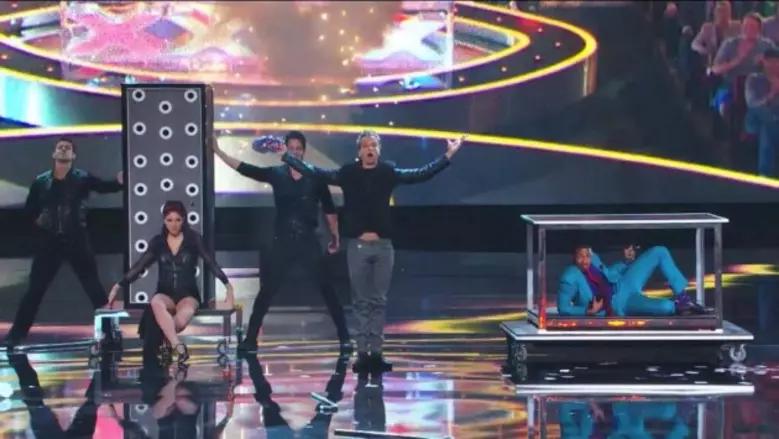
There are magic acts that make you smile, magic acts that make you scratch your head, and then there are illusion acts that leave an entire room wondering whether reality has quietly taken the evening off.
Echo Illusionists belong firmly in that third category.
With a performance built around mystery, theatrical presentation and just the right amount of comedy, the illusionist duo has the kind of concept that feels tailor-made for America’s Got Talent. A Golden Buzzer moment on the show is supposed to deliver something audiences will remember long after the applause fades, and an act like Echo Illusionists has all the ingredients for exactly that kind of television magic.
Of course, the real secret behind a successful illusion is not simply what happens onstage. It is everything the audience does not see.
And that is where the story gets particularly funny.

The Magic Starts Long Before the Curtain Opens
For viewers watching at home, an illusion can look effortless.
A box appears.
A person disappears.
An object changes.
The audience screams.
The judges stare in disbelief.
Then everyone applauds.
Behind the scenes, however, there is usually considerably less mystery and considerably more organized chaos.
An illusionist may spend hours checking props, rehearsing movements and making sure every tiny detail is in exactly the right place. One misplaced object can turn a perfectly timed trick into an extremely expensive comedy sketch.
For Echo Illusionists, the backstage world can be imagined as a place where serious concentration meets ridiculous last-minute problems.
Someone is checking a prop.
Someone else is checking it again.
Another person is asking, “Where did that box go?”
And somewhere in the background, an illusionist is probably saying the most terrifying sentence in magic:
“It worked perfectly during rehearsal.”
That sentence has launched more nervous looks backstage than almost anything else.
The Golden Buzzer Dream
For any America’s Got Talent performer, the Golden Buzzer represents more than a loud sound and a shower of golden confetti.
It represents a massive vote of confidence.
When a judge or other authorized person hits the Golden Buzzer, the contestant can be sent directly through to a later stage of the competition, turning an ordinary audition into an unforgettable television moment.
For illusionists, that pressure can be particularly intense.
Unlike a singer, who can often recover from a missed note, an illusionist has to make complicated pieces of choreography, props, timing and audience attention work together.
If the timing is perfect, the audience sees a miracle.
If the timing is slightly wrong, the audience may see a magician desperately trying to remember where the emergency plan is.
That is why preparation is everything.
Behind the Scenes: Where the Real Comedy Happens
The funniest part of an illusionist’s performance may actually happen before the cameras roll.
Imagine the rehearsal room.
A mysterious box sits in the middle of the stage.
The performers are whispering.
A crew member walks past and stops.
“Is that supposed to be there?”
“Yes.”
“Are you sure?”
“Absolutely.”
Five minutes later, everyone is looking for the same box.
That is the unofficial backstage version of magic.
Props also have a remarkable ability to become stars in their own right. A simple table can suddenly require a full technical briefing. A curtain can become a major logistical challenge. A small object that takes three seconds to use on television might require hours of preparation.
And then there is the classic backstage question:
“Can we make this look more mysterious?”
The answer from an illusionist is almost always yes.
The answer from the production crew may be, “Please don’t make it any more complicated.”
The Art of Making Judges Doubt Their Own Eyes
The greatest illusion performances do not simply demonstrate a trick. They tell a story.
That is particularly important on America’s Got Talent, where contestants have only a limited amount of time to convince four judges and a huge television audience that they deserve another chance.
A strong illusionist knows that the audience should not spend the entire performance thinking about how the trick works.
Instead, viewers should become emotionally involved.
They should laugh.
They should become nervous.
They should wonder what is coming next.
And, ideally, they should reach the moment where they simply give up trying to figure it out.
That is the sweet spot.
Echo Illusionists, with a name that already suggests mystery and repetition, has a natural theatrical identity. The word “Echo” evokes something that returns when you least expect it, while “Illusionists” immediately promises a world where nothing is necessarily what it appears to be.
That combination could make for a memorable stage brand.
When the Audience Starts Helping the Magician
One of the funniest things about watching illusion shows is how quickly audience members become amateur detectives.
Someone sees a suspicious movement and immediately thinks they have solved the entire trick.
“I KNOW HOW THEY DID IT!”
Thirty seconds later, the performer does something completely different.
The same audience member suddenly sits quietly.
The confidence disappears.
The investigation is over.
This is one of the great joys of stage magic.
Everybody wants to discover the secret.
Nobody wants to admit they were completely wrong.
On a show as large as America’s Got Talent, that reaction becomes part of the entertainment itself. The judges may try to analyze the performance, but eventually even experienced entertainers can find themselves staring at the stage with the same expression as everyone at home.
The Serious Business of Looking Completely Relaxed
There is another secret to successful illusion: confidence.
Even when something backstage goes wrong, the performer cannot walk onto the stage looking worried.
That creates one of the funniest contrasts in live entertainment.
Backstage:
“Where is the prop?”
“Who moved the table?”
“Is the microphone working?”
“Did anyone see the costume?”
Onstage:
“Good evening, everyone.”
Completely calm.
Completely confident.
As if nothing in the world has ever gone wrong.
That ability to stay composed is part of what makes professional illusionists so fascinating. The audience sees control. Behind the curtain, there may be twenty people making sure that control is possible.
Why Magic Continues to Work on AGT
Magic and illusion have always had a special place on talent competitions because they create an immediate reaction.
A great singer can move people emotionally.
A great dancer can amaze them physically.
But an illusionist can make an audience question reality itself.
That is a powerful television tool.
The best performances also create something social. Viewers at home immediately want to talk about what they saw.
“How did they do that?”
“Did you see the box?”
“Watch it again!”
“There’s no way!”
And suddenly the performance has become a conversation.
That is exactly what a memorable talent-show audition needs.
The Golden Buzzer Fantasy
For Echo Illusionists, the ultimate dream would naturally be the moment when the Golden Buzzer is activated and golden confetti fills the stage.
It is the sort of television moment contestants imagine long before they ever walk onto the audition stage.
The performers have spent months—or potentially years—perfecting their craft.
Then comes the audition.
The lights come up.
The music starts.
The audience goes silent.
The illusion begins.
For a few minutes, nothing else matters.
And if everything goes according to plan, the audience gets what every magician wants to create:
A moment they cannot explain.
What Happens After the Applause?
The challenge for any Golden Buzzer-level act is that the biggest performance is never necessarily the final performance.
Once an act makes a major impression, expectations become much higher.
The next illusion has to be bigger.
The next surprise has to be stronger.
The comedy has to remain fresh.
And the performers must somehow continue fooling people who are now actively looking for the secret.
That is the real test.
For Echo Illusionists, the most exciting possibility would be to build an identity around more than simply “How did they do that?”
The strongest illusion acts combine mystery with personality.
They make people laugh before they make them gasp.
They make judges nervous before making them applaud.
And they create moments that viewers want to replay immediately.
A Little Magic, a Lot of Chaos
Ultimately, the charm of an act like Echo Illusionists is that magic does not have to be completely serious.
Behind every impossible moment is a very human story involving rehearsal, nerves, misplaced props, complicated equipment and performers desperately hoping that everything works when the cameras begin rolling.
That combination of professionalism and backstage chaos is what makes illusion so entertaining.
Onstage, the performers may appear to control reality.
Backstage, reality is probably controlling them.
And perhaps that is the funniest illusion of all.
Whether Echo Illusionists ultimately becomes a Golden Buzzer story, a viral audition sensation or simply an imaginative name for a magical entertainment act, the formula is clear: mystery gets attention, comedy makes the audience comfortable, and a genuinely astonishing illusion gives viewers something they cannot stop talking about.
Because when the final curtain falls and the applause fades, there is only one question that really matters:
How on earth did they do that?
And for an illusionist, there may be no better question to leave behind.