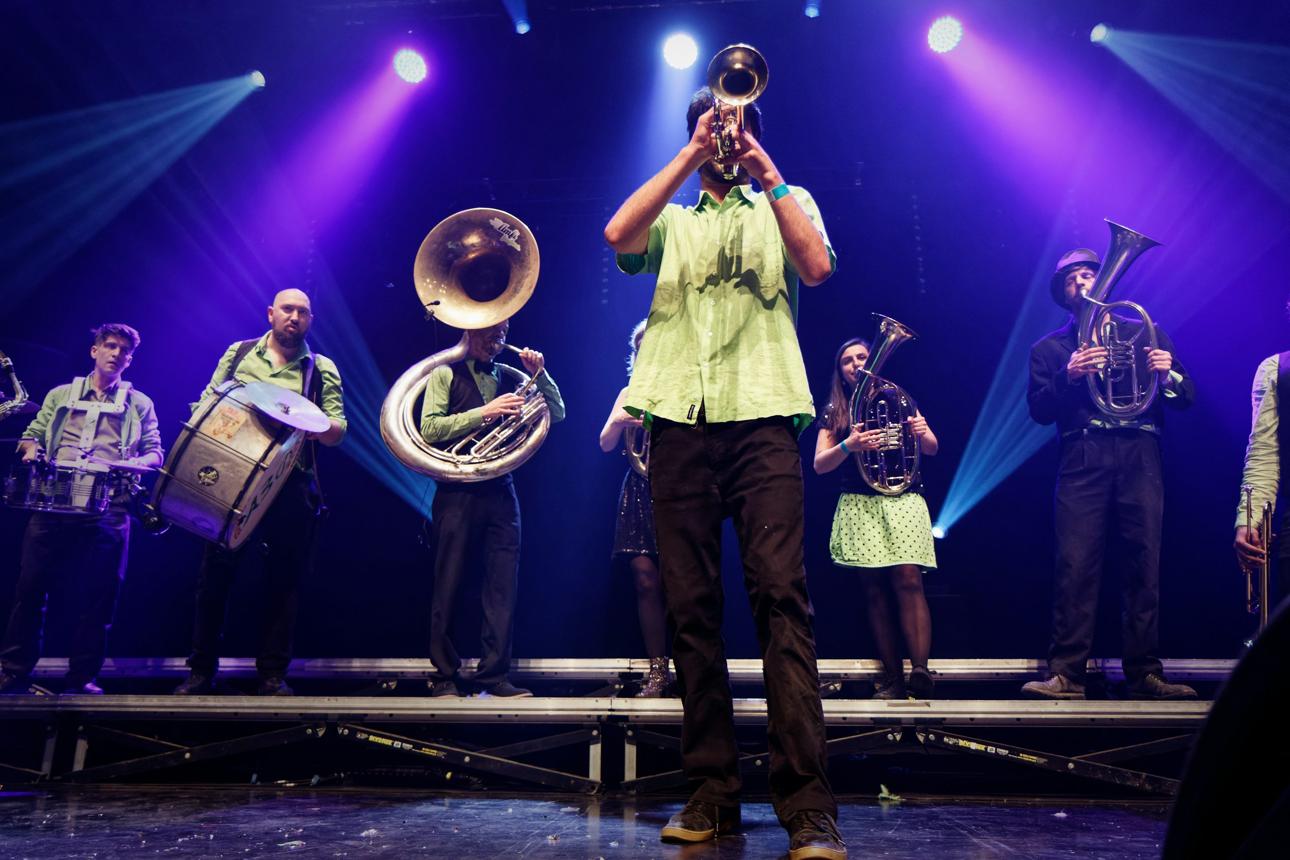
The name Midnight Brass sounds mysterious, stylish and sophisticated.
The reality backstage was considerably less glamorous.
Before the fictional America’s Got Talent audition that would turn the group into one of the show’s most talked-about acts, Midnight Brass was dealing with a missing trumpet mouthpiece, a tangled microphone cable, one nervous trombone player and a saxophonist who accidentally brought two left shoes.
Nobody knew how the shoes happened.
Nobody wanted to ask.
But somehow, the group made it onto the stage.
And once the lights came on, the chaos disappeared.
What followed was an energetic brass performance filled with trumpets, trombones, saxophones, percussion, choreography and enough personality to make the entire theater move.
By the end, the audience was standing.
The judges were cheering.

And gold confetti was falling from the ceiling.
A Band With a Big Sound
Midnight Brass was created by a fictional group of young musicians who wanted to prove that brass music could be exciting for a modern television audience.
The group blended traditional brass instruments with contemporary rhythms.
Trumpets carried the melodies.
Trombones delivered powerful low notes.
Saxophones added color.
Percussion provided the beat.
And the performers themselves became part of the choreography.
They didn’t simply stand in a line and play.
They moved.
They danced.
They interacted.
They turned the performance into a party.
The Idea Behind the Name
The group’s name came from their original rehearsal schedule.
Many of the members worked during the day.
That meant rehearsals often happened late at night.
Sometimes they didn’t begin until 10 p.m.
Sometimes they finished after midnight.
One member joked:
“We’re either Midnight Brass or Extremely Tired Brass.”
The name stuck.
Early Rehearsals Were Loud
Very loud.
The first time the full group rehearsed together, a neighbor reportedly knocked on the door.
“Are you practicing?”
The group said yes.
The neighbor paused.
“Could you practice a little quieter?”
The group tried.
It didn’t work.
Brass instruments are not famous for being quiet.
Eventually, they found a larger rehearsal space.
Everyone’s ears appreciated the decision.
Audition Day
The fictional AGT audition day began before sunrise.
The musicians arrived carrying instrument cases.
Trumpets.
Trombones.
Saxophones.
Percussion equipment.
Music stands.
Microphones.
Cables.
And enough accessories to fill a small truck.
One production assistant looked at the equipment and asked:
“How long is the performance?”
“About three minutes.”
The assistant stared.
“Three minutes?”
The band leader nodded.
The assistant looked at the mountain of equipment again.
“I see.”
The Missing Mouthpiece
The first backstage crisis involved a trumpet mouthpiece.
One trumpet player couldn’t find it.
The search began.
Inside the case.
Under the chair.
In the backpack.
On the table.
Nothing.
The musician started panicking.
Then another band member asked:
“Did you check your pocket?”
He checked.
There it was.
Everyone stared.
He laughed.
“I knew that.”
Nobody believed him.
The Two Left Shoes
Then came the shoes.
The band’s saxophonist discovered he had packed two shoes that were both designed for the same foot.
He looked down.
Looked at the shoes.
Looked back at the group.
“I have a problem.”
Someone asked:
“What kind?”
He held them up.
“An extremely specific one.”
Fortunately, a backup pair was found.
The group moved on.
Sound Check
Sound check was another adventure.
Brass instruments can be powerful.
Very powerful.
The sound engineer had to balance the trumpets against the trombones and saxophones.
The percussion section needed its own microphones.
The vocal microphone needed testing.
The stage monitors needed adjusting.
The band played a short section.
The sound engineer stopped them.
“Trumpets, a little softer.”
The trumpet players nodded.
They played again.
“Still softer.”
They nodded again.
Finally, one trumpet player whispered:
“We’re already whispering.”
Everyone laughed.
The Performance
When Midnight Brass walked onto the stage, the audience applauded.
The performers stood in formation.
The lights dimmed.
A single spotlight appeared.
The percussionist tapped a drum.
Boom.
A trumpet answered.
Ba-da-da!
The trombones joined.
Then the saxophones.
Within seconds, the theater was filled with sound.
A Brass Party on Stage
The performance was designed to build gradually.
It started with a simple rhythm.
Then another instrument joined.
Then another.
The performers began moving.
They stepped forward.
Turned.
Changed formation.
Raised their instruments.
The energy increased.
The audience began clapping.
Then the main melody arrived.
The brass section exploded into sound.
The Trombone Moment
One of the highlights was a trombone solo.
The performer stepped forward.
The music stopped behind him.
He played a dramatic sequence.
The audience cheered.
Then the entire band came back in.
It was loud.
Energetic.
And completely theatrical.
Backstage, another performer later joked:
“He practiced that solo approximately 4,000 times.”
The trombone player replied:
“And it was worth every one.”
The Accidental Dance Move
Midway through the performance, one trumpet player made a small mistake.
Instead of turning left, he turned right.
He immediately corrected himself.
But the move looked so intentional that the audience cheered.
The band leader noticed.
Afterward, he laughed.
“We’re keeping that.”
The accidental mistake had officially become choreography.
The Big Finish
As the performance reached its final section, the rhythm accelerated.
Trumpets played the melody.
Trombones added power.
Saxophones filled the gaps.
Percussion drove the beat.
The performers moved toward the front of the stage.
Then they stopped.
Silence.
One final trumpet note.
BOOM.
The audience erupted.
Standing Ovation
Everyone stood.
The performers looked at one another.
Some laughed.
Some smiled.
One member appeared close to tears.
The band leader looked toward the audience.
His family was standing.
His friends were cheering.
The judges applauded.
Then came the Golden Buzzer.
Golden Confetti Meets Brass
The Golden Buzzer was pressed.
Gold confetti exploded above the group.
The performers screamed.
One trumpet player raised his instrument.
Another jumped.
A trombone player accidentally dropped his slide.
Everyone laughed.
Confetti flew into the instruments.
One piece landed inside a trumpet bell.
The trumpet player looked down.
“That’s going to affect the acoustics.”
His bandmate replied:
“It’s gold. It probably improves them.”
Backstage Celebration
The group rushed backstage.
Their families were waiting.
There were hugs.
Tears.
High-fives.
Laughter.
One parent tried to remove confetti from a performer’s hair.
Another piece immediately landed on their shoulder.
The group quickly realized they weren’t getting rid of the gold paper anytime soon.
The Interview
During the backstage interview, the band leader was asked how he felt.
He smiled.
“I don’t think we’ve processed it yet.”
The interviewer asked:
“What was going through your mind during the performance?”
He laughed.
“Mostly, don’t drop the trumpet.”
The other members laughed.
Apparently, that had been the unofficial group motto all day.
The Internet Reacts
When the fictional audition aired, Midnight Brass quickly attracted attention.
Viewers loved the energy.
Fans praised the musicianship.
Others enjoyed the choreography.
The accidental dance move became a viral joke.
Fans started calling it “The Midnight Turn.”
The trumpet player embraced it.
He began including the move in rehearsal.
Preparing for the Next Round
The Golden Buzzer meant the group would move forward.
But now the pressure increased.
They needed a new performance.
Something bigger.
Something different.
The band started experimenting with arrangements.
More choreography.
New rhythms.
Different brass combinations.
They wanted to prove that the first performance wasn’t a fluke.
The Challenge of Playing and Dancing
Playing a brass instrument while dancing is not easy.
Breathing becomes more difficult.
Timing becomes complicated.
Movement affects posture.
The group practiced repeatedly.
One rehearsal ended when the trombone player nearly collided with the saxophonist.
Everyone stopped.
Silence.
Then laughter.
The band leader shook his head.
“Let’s try that section again.”
Behind the Music
Midnight Brass discovered that the biggest part of their success wasn’t simply musical ability.
It was teamwork.
Every performer had to listen.
Every rhythm needed to match.
Every movement had to be synchronized.
One person making a mistake could affect everyone.
That forced the musicians to trust one another.
The Crew Behind the Curtain
The group also learned to appreciate the production team.
Sound engineers had to capture every instrument.
Lighting technicians timed changes to the music.
Camera operators followed moving performers.
Stage managers coordinated equipment.
Production assistants kept instruments and cables organized.
Without those people, Midnight Brass couldn’t create its television performance.
Why the Group Connected
Midnight Brass succeeded because it made brass music feel fresh.
The performers weren’t trying to hide the instruments.
They celebrated them.
They made them powerful.
They made them funny.
They made them exciting.
Most importantly, they invited the audience to have fun.
The Funniest Backstage Moment
After the Golden Buzzer, the band began packing.
Trumpets?
Packed.
Saxophones?
Packed.
Trombones?
Packed.
Percussion?
Packed.
Music stands?
Packed.
Then someone asked:
“Where’s the mouthpiece?”
Everyone froze.
The same missing-mouthpiece problem had returned.
They searched.
Finally, they found it.
It was sitting inside the trumpet case.
The trumpet player stared at it.
“That’s where I put it.”
Someone answered:
“Exactly.”
The group burst into laughter.
A Golden Sound
Midnight Brass’s fictional AGT journey wasn’t simply about winning a Golden Buzzer.
It was about showing that traditional instruments could still create something modern, energetic and unforgettable.
Their performance combined musicianship with humor.
Discipline with personality.
Tradition with modern entertainment.
And backstage chaos with onstage precision.
They arrived carrying instruments.
They left carrying memories.
And quite a lot of confetti.
The group’s story offered one final lesson:
You don’t need to be perfectly calm to create something extraordinary.
Sometimes you can lose a mouthpiece, wear two left shoes, accidentally turn the wrong direction and still walk onto the biggest stage of your life.
As long as you remember one important thing: