Gravity is supposed to be one of those things humans simply have to accept.
You jump.
You come down.
You stand on the floor.
That’s how life works.
Apparently, nobody told Gravity Kings.
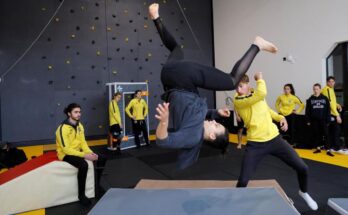
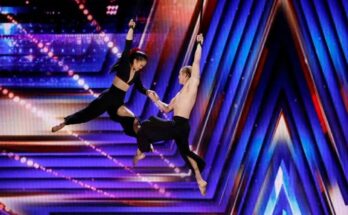
The fictional acrobatics group arrived at an America’s Got Talent–style audition determined to make gravity look optional. Their routine combined tumbling, balancing, partner acrobatics, synchronized movement and spectacular jumps.
But before the performance, the biggest challenge wasn’t gravity.
It was finding a missing costume.
Then came a runaway shoe.
Then a rehearsal that ended with three performers laughing on the floor.
By the time Gravity Kings finally walked onto the stage, the backstage team had already witnessed enough comedy to fill an entire episode.
Yet when the spotlight appeared, the jokes stopped.
The performers became completely focused.
And for several breathtaking minutes, Gravity Kings made an enormous television stage look like a playground.

The Beginning of the Gravity Kings
Gravity Kings was formed by a fictional group of six athletes who met through gymnastics and acrobatics competitions.
Their backgrounds were different.
Some had experience in gymnastics.
Others came from tumbling.
One performer specialized in hand balancing.
Another focused on aerial movement.
Eventually, they realized that their individual talents could combine into something much bigger.
They created a group built around one concept:
What if gravity became part of the choreography?
Instead of fighting gravity, they wanted to use it.
Jumps became transitions.
Falls became tricks.
Balance became storytelling.
Every movement was designed to look impossible while remaining carefully controlled.
Training Was Serious Business
Gravity Kings trained for hours.
Their rehearsals were physically demanding.
They practiced landings.
They worked on timing.
They strengthened their core muscles.
They repeated complicated partner moves.
A trick might take weeks to perfect.
Sometimes months.
The performers learned that an impressive stunt on television is usually the result of hundreds of ordinary repetitions.
The audience sees the final attempt.
The athletes remember all the attempts that came before it.
Audition Day Starts With Trouble
The fictional AGT audition day began with the performers arriving early.
They carried gym bags filled with costumes, shoes, tape, chalk and safety equipment.
Everything was organized.
At least, that was the plan.
Then one performer discovered that his costume top was missing.
Everyone searched.
Nothing.
He checked his bag.
Nothing.
Someone checked the dressing room.
Nothing.
Finally, another performer pointed toward a chair.
The missing costume was hanging there.
The performer stared.
“I put it somewhere safe.”
His teammate laughed.
“Apparently too safe.”
The Runaway Shoe
The next problem was even stranger.
During warm-ups, one performer’s shoe came off during a tumbling pass.
It flew across the rehearsal space.
Everyone stopped.
The shoe landed near a production assistant.
The assistant picked it up.
“Is this yours?”
The performer raised his hand.
“Yes.”
The assistant looked at the shoe.
“Would you like it back?”
“Please.”
Everyone laughed.
The group decided that their unofficial audition rule would be:
Keep all clothing attached.
Backstage Nerves
Despite the jokes, the athletes were nervous.
This was their biggest performance ever.
Their routine included several high-risk-looking moments.
They knew millions of viewers might eventually watch.
Their coach reminded them:
“Trust your training.”
That became their mantra.
They repeated it before walking onto the stage.
The Stage
The Gravity Kings stage setup was simple.
A large performance area.
Spring floor.
Lighting equipment.
A few platforms.
Nothing too complicated.
The performers wanted the audience to focus on movement.
The first lights dimmed.
The group walked onto the stage.
The crowd applauded.
Then the music began.
The Opening Move
One performer stepped forward.
He dropped into a handstand.
Another ran toward him.
The first performer kicked upward.
The second jumped over him.
The audience gasped.
Then three more performers joined.
Within seconds, the stage became a blur of movement.
Flips.
Spins.
Jumps.
Catches.
Balances.
The First Big Formation
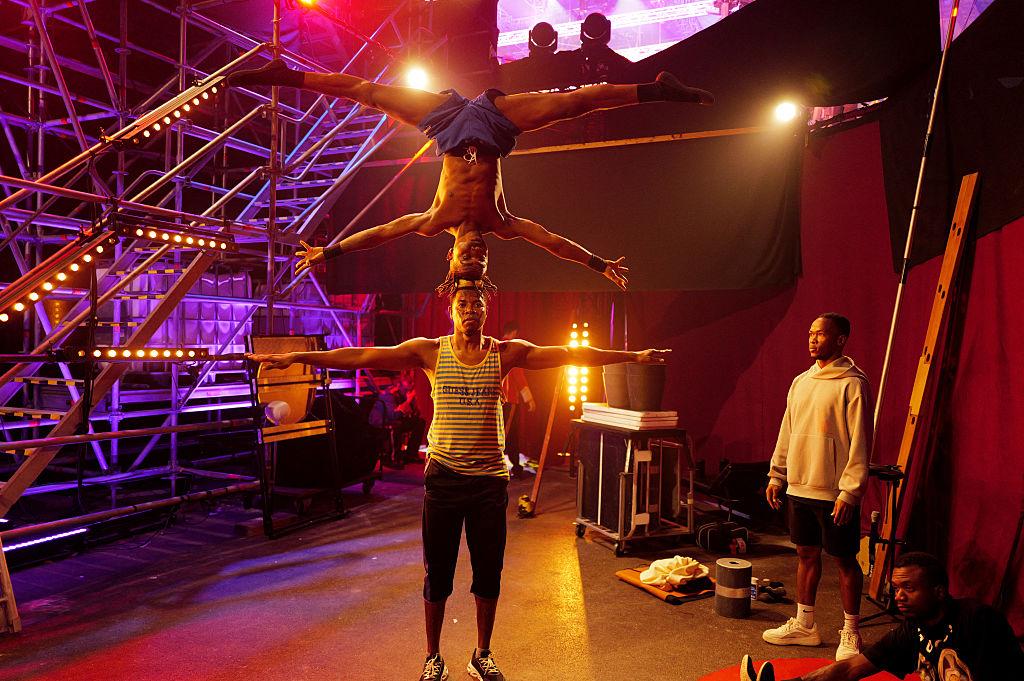
The group formed a human pyramid.
One performer climbed onto another.
A third stepped into position.
Then another.
The pyramid rose.
The audience became silent.
At the top, one performer stood on one leg.
He held the position.
The crowd erupted.
Then he jumped down.
The entire formation dissolved perfectly.
The Impossible Catch
The most dramatic moment came when one performer sprinted across the stage.
He jumped.
For a moment, he appeared to be flying.
Another performer caught him.
The audience screamed.
The judges stood.
The catch had been practiced countless times.
On television, it looked effortless.
Backstage, the coach probably held her breath.
The Comedy Returns
After the most dangerous sequence, one performer landed and accidentally slid several feet across the stage.
The audience laughed.
He immediately stood up and bowed.
The group continued.
Later, he joked that the slide was “completely intentional.”
Nobody believed him.
But it made the audience love him even more.
Synchronized Tumbling
The next section featured all six performers tumbling simultaneously.
They ran.
Jumped.
Flipped.
Landed.
Rolled.
And stood at exactly the same moment.
The timing was extraordinary.
One mistake could have ruined the sequence.
Instead, it was perfect.
The audience erupted again.
The Final Trick
For the finale, Gravity Kings created their biggest formation.
Five performers formed the base.
The sixth climbed upward.
Higher.
Higher.
The audience watched nervously.
At the top, the performer extended his arms.
The music stopped.
Silence.
Then he jumped.
He rotated through the air.
The group caught him.
The final landing was synchronized.
The music ended.
Silence.
Then chaos.
The Standing Ovation
The audience jumped to its feet.
The judges stood.
The performers hugged one another.
One athlete dropped to the floor and covered his face.
Another looked toward his family.
His mother was crying.
His father was cheering.
The group had done it.
Then came the Golden Buzzer.
Gold From the Sky
One judge reached for the Golden Buzzer.
The button was pressed.
Gold confetti exploded above the performers.
They screamed.
One performer jumped again—perhaps the last jump he needed for the day.
Another tried to catch falling confetti.
A third simply stood there with his mouth open.
Then the group hugged.
The stage was covered in gold.
Gravity had officially lost.
The Confetti Problem
Backstage, the performers quickly discovered that confetti has a remarkable ability to travel.
It got into:
- Shoes
- Hair
- Gym bags
- Costumes
- Water bottles
- Equipment cases
One performer found a piece inside his sock.
Another discovered confetti stuck to his elbow.
The coach laughed.
“Congratulations. You’re glittering.”
Family Celebration
The athletes’ families joined them backstage.
There were hugs.
Tears.
Laughter.
One parent immediately asked:
“Are you okay?”
The performer nodded.
“Yes.”
“Any injuries?”
“No.”
“Then why are you lying on the floor?”
The performer laughed.
“Because I’m tired.”
The Backstage Interview
During the fictional interview, the group was asked what it felt like to receive the Golden Buzzer.
The leader answered:
“It feels unbelievable.”
Another performer added:
“And exhausting.”
Everyone laughed.
The interviewer asked:
“What was the hardest part?”
The athlete thought about it.
“Finding my costume.”
The group erupted.
Fans Discover Gravity Kings
When the fictional audition aired, viewers quickly responded.
Fans loved the athletic ability.
Others praised the synchronization.
Clips of the human pyramid and final catch circulated online.
People began calling the group “the boys who broke gravity.”
The group embraced the nickname.
Their fictional social media page posted:
“Gravity called. We didn’t answer.”
Preparing for the Next Stage
The Golden Buzzer meant Gravity Kings could continue.
But now the pressure was greater.
Their next performance had to be even more impressive.
The group began creating new routines.
Higher jumps.
More complicated formations.
New choreography.
But safety remained their top priority.
Every new stunt was tested repeatedly.
The Serious Side of the Spectacle
The humor surrounding Gravity Kings shouldn’t hide the discipline behind their performances.
These athletes train constantly.
They build strength.
Improve flexibility.
Study technique.
Practice landings.
Work on communication.
Trust their teammates.
The audience sees three minutes of excitement.
The performers carry years of training into those three minutes.
The Crew Behind the Performance
The production team also played a crucial role.
Stage managers ensured the floor was ready.
Lighting technicians timed every cue.
Camera operators tracked fast-moving athletes.
Sound engineers synchronized music.
Safety professionals monitored equipment.
Wardrobe teams secured costumes.
Every detail mattered.
The performers might appear to be defying gravity.
But behind the scenes, an enormous team was making sure they could do it safely.
The Funniest Moment of the Day
After the Golden Buzzer celebration, Gravity Kings began packing.
One performer searched for his phone.
Nothing.
He checked his bag.
Nothing.
He checked the dressing room.
Nothing.
Finally, someone found it.
It was sitting on top of his head.
The entire group laughed.
He stared at the phone.
“I’ve been looking for this for ten minutes.”
Someone replied:
“Maybe gravity put it there.”
Why Gravity Kings Connected With Audiences
The group wasn’t memorable simply because they could perform difficult tricks.
They were memorable because they looked like they were having fun.
They smiled.
They joked.
They supported each other.
And when something went slightly wrong, they didn’t panic.
They kept going.
That confidence made audiences feel connected to them.
More Than Tricks
At its heart, Gravity Kings was a story about trust.
Every catch depended on another person.
Every formation required teamwork.
Every jump required preparation.
The group couldn’t succeed individually.
They had to succeed together.
That made the Golden Buzzer moment even more meaningful.
The button didn’t simply recognize athletic ability.
It recognized a team.
The Road Ahead
Gravity Kings left the fictional audition covered in gold confetti, carrying their equipment and laughing about everything that had gone wrong.
The missing costume had been found.
The runaway shoe had been recovered.
The phone had been located.
And nobody had accidentally fallen off the stage.
By their standards, it was a perfect day.
Their journey was only beginning.
The next challenge would be bigger.
The tricks would become harder.
The audience would expect more.
But Gravity Kings had already learned the most important lesson:
You don’t actually have to defeat gravity.
You just need to know how to work with it.
And if your costume goes missing along the way?