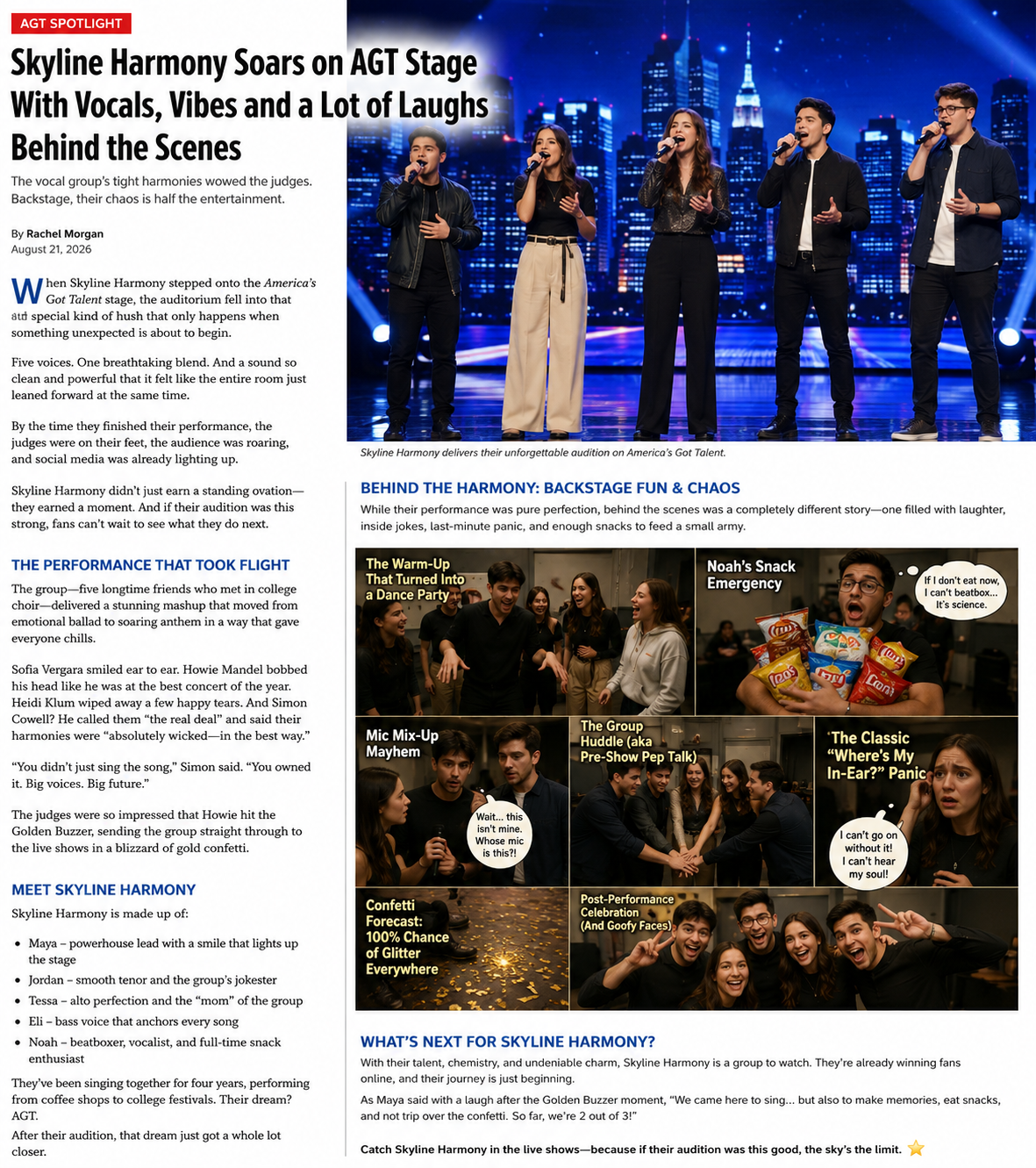
When Skyline Harmony stepped onto the America’s Got Talent stage, the atmosphere changed almost immediately.
Five performers stood together under the bright audition lights, looking calm enough to convince everyone that they had absolutely nothing to worry about.
That impression lasted approximately thirty seconds.
Once the music began, however, the nerves disappeared. Their voices blended into a polished wall of harmony, building from a gentle opening into a powerful finish that had the audience cheering before the final note had even faded.
The performance had all the ingredients of a memorable talent-show moment: strong vocals, impressive chemistry, a little drama and, perhaps most importantly, five performers who looked like they were genuinely having fun.
But if the stage performance looked perfectly controlled, the story behind the scenes was considerably more chaotic.
Five Voices, One Big Dream
Skyline Harmony is imagined as a vocal group whose members discovered their shared chemistry through years of singing together.
The group consists of five friends with different vocal personalities. One brings the soaring lead vocals, another provides smooth tenor harmonies, while the remaining members add bass, rhythm and supporting vocals that give the group its distinctive sound.
Their biggest strength isn’t simply individual talent.
It’s the way they listen to one another.
In a vocal group, one person singing beautifully isn’t enough. Every singer has to know when to step forward and when to disappear into the harmony. A single mistimed entrance can change an entire arrangement.
Skyline Harmony appears to understand that balance.
Their performance feels less like five people singing at the same time and more like one musical instrument with five different voices.
That kind of chemistry doesn’t happen overnight.
It takes rehearsal.
And lots of it.
The Rehearsals Were Not Always Elegant
From the audience, rehearsals can seem glamorous.
Behind closed doors, they’re usually anything but.
Skyline Harmony’s preparation reportedly comes with the usual collection of missed notes, forgotten lyrics, accidental laughter and somebody asking the question every vocal group eventually hears:
“Can we do that part again?”
The answer is almost always yes.
Again.
And again.
And again.
Eventually, somebody starts joking that the group should simply move into the rehearsal room permanently.
The funny thing about group rehearsals is that everyone has a different definition of “one more time.”
For one person, it means one final run-through.
For another, it means six more attempts.
And there is always one person who says, “I think we’ve got it,” immediately before forgetting the next line.
Skyline Harmony’s backstage personality is reportedly just as important as its musical ability. The members joke with each other, tease whoever makes the biggest mistake and use humor to keep the nerves under control.
That becomes particularly important before an audition as enormous as AGT.
The Snack Emergency
Every serious performance group needs vocal warm-ups.
Skyline Harmony apparently also needs snacks.
There is always one member of a group who treats food preparation like an Olympic event.
For Skyline Harmony, that person might be Noah, the fictional group’s self-appointed snack specialist.
While everyone else is discussing harmonies and stage positions, Noah is checking whether anyone has seen his emergency snack box.
Nobody knows why an emergency snack box is necessary.
Nobody asks.
They simply accept that it exists.
Then, about twenty minutes before the performance, disaster strikes.
The snack box is missing.
Suddenly, a five-person vocal group becomes a five-person detective agency.
“Where did you put it?”
“I didn’t touch it.”
“You were sitting next to it.”
“That doesn’t mean I touched it.”
“Then where is it?”
A dramatic search begins.
Eventually, the box is discovered exactly where Noah left it.
On top of his own bag.
The emergency is declared over.
The group returns to rehearsing.
No one mentions that the entire crisis lasted longer than some of their vocal warm-ups.
When the Microphone Goes Missing
Then comes another backstage classic: the microphone mix-up.
For a vocal group, microphones are not exactly optional.
Every singer needs to know which microphone belongs to them, and every microphone needs to be tested.
That sounds simple.
It isn’t.
Someone picks up the wrong microphone.
Someone else checks the wrong channel.
A crew member asks, “Whose mic is this?”
Three people answer simultaneously.
Then everyone laughs.
The technical crew patiently sorts everything out while the performers try not to look guilty.
This is the kind of moment viewers never see.
On television, the microphones work perfectly.
Backstage, there may be five people staring at five identical microphones trying to remember which one they were holding thirty seconds earlier.
The Final Minutes Before the Audition
As the audition approaches, the joking becomes quieter.
The performers know what is coming.
The judges are waiting.
The audience is waiting.
The cameras are ready.
And suddenly, all those months of rehearsal have been reduced to a few minutes.
This is the moment when nerves can become overwhelming.
Skyline Harmony’s secret weapon is likely the same thing that brought them together in the first place: each other.
Instead of thinking about thousands of people watching, they focus on the five people standing beside them.
One singer checks the next.
Someone squeezes another member’s hand.
Someone makes one last terrible joke.
Everybody laughs.
And then the stage manager gives them the signal.
It’s time.
The Performance Takes Flight
When Skyline Harmony begins singing, the nervous backstage group seems to disappear.
What replaces it is confidence.
The opening is controlled and intimate. Each voice enters carefully, allowing the arrangement to grow naturally.
Then the harmonies expand.
The sound becomes bigger.
The audience responds.
By the final section, Skyline Harmony isn’t simply performing a song. They’re creating a moment.
That is the difference between singing a song correctly and delivering a performance people remember.
The judges watch closely.
The audience leans forward.
The final note arrives.
Silence.
Then applause.
And lots of it.
For a few seconds, the five members simply stand there, taking in what has happened.
They did it.
Backstage Chaos Returns Immediately
The second they leave the stage, however, the polished television image disappears.
One member asks:
“Did we actually do it?”
Another replies:
“I think so.”
“Did I miss my entrance?”
“No.”
“Are you sure?”
“Yes.”
“Did anybody hear me breathe into the microphone?”
Everyone starts laughing.
This is when the adrenaline finally hits.
There are hugs.
There are nervous laughs.
There may even be a few tears.
And then someone notices that one member’s shoe is untied.
Of course it is.
Nobody noticed it during the performance.
Fortunately, the shoe survived.
The dignity of the group is another matter.
Why Chemistry Matters More Than Perfection
Skyline Harmony’s biggest advantage isn’t necessarily that every note is perfect.
It’s chemistry.
Audiences can recognize when performers genuinely enjoy working together.
That connection is difficult to manufacture.
Five technically brilliant singers can perform a flawless arrangement and still feel disconnected.
Five friends who trust each other can sometimes create something much more powerful.
They react to one another.
They smile at one another.
They recover from small mistakes together.
And when something unexpected happens, they don’t panic.
They adapt.
That quality can be especially valuable in a live competition.
The Golden Buzzer Dream
For any AGT act, there is always one dream hanging over the stage: the Golden Buzzer.
The button has become one of the show’s most recognizable symbols.
A judge presses it, golden confetti fills the stage and the contestant advances in the competition.
For an act like Skyline Harmony, the Golden Buzzer would represent more than simply moving forward.
It would be a confirmation that the five friends had created something powerful enough to stop the judges in their tracks.
And just imagine the backstage reaction.
Five people.
One button.
Thousands of pieces of confetti.
At least one person crying.
And probably Noah trying to protect his snack box from the falling gold paper.
The Confetti Problem
Nobody talks enough about what happens after the Golden Buzzer.
Confetti gets everywhere.
On the stage.
On the performers.
In their hair.
Inside their clothes.
Possibly inside someone’s shoe.
A contestant can spend months preparing a perfectly choreographed performance, only to finish by spending the next five minutes attempting to remove tiny pieces of gold paper from their ears.
Skyline Harmony would almost certainly discover this firsthand.
One member might look completely emotional while another is quietly picking confetti off their jacket.
Someone will inevitably say:
“Do we have to clean this up?”
The answer is no.
But someone backstage definitely does.
What Comes Next for Skyline Harmony?
If Skyline Harmony continues its journey, the challenge becomes even greater.
Auditions are about making an impression.
The next stages are about proving that the impression wasn’t a one-time event.
The group would need to choose increasingly ambitious arrangements while protecting the vocal chemistry that made the original performance special.
That means bigger production doesn’t necessarily have to mean louder singing.
Sometimes the most effective performance is the one that knows when to become quiet.
Skyline Harmony’s ability to balance power with restraint could become one of its greatest strengths.
A Group to Watch
Whether the spotlight brings them another standing ovation, a Golden Buzzer moment or simply a growing fan base, Skyline Harmony has the ingredients of an act viewers can connect with.
The talent is important.
The harmonies are important.
But the friendship may be the real story.
Behind the polished stage lights are five people who rehearse until they are exhausted, laugh when things go wrong, search for missing microphones, argue about snacks and encourage each other when the pressure becomes overwhelming.
That’s what makes the group feel human.
And perhaps that’s the secret to a great America’s Got Talent performance.
The audience doesn’t just want to hear something impressive.
They want to see people chasing a dream together.
Skyline Harmony may bring the soaring vocals to the stage, but behind the scenes, they’re bringing something equally entertaining: friendship, nerves, laughter and just enough chaos to remind everyone that even the most polished performers are still human.
For now, the sky is the limit.
And hopefully, someone has remembered where Noah put the snacks.