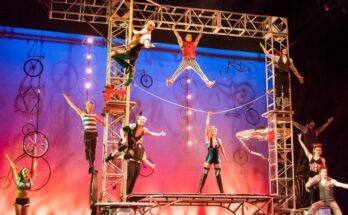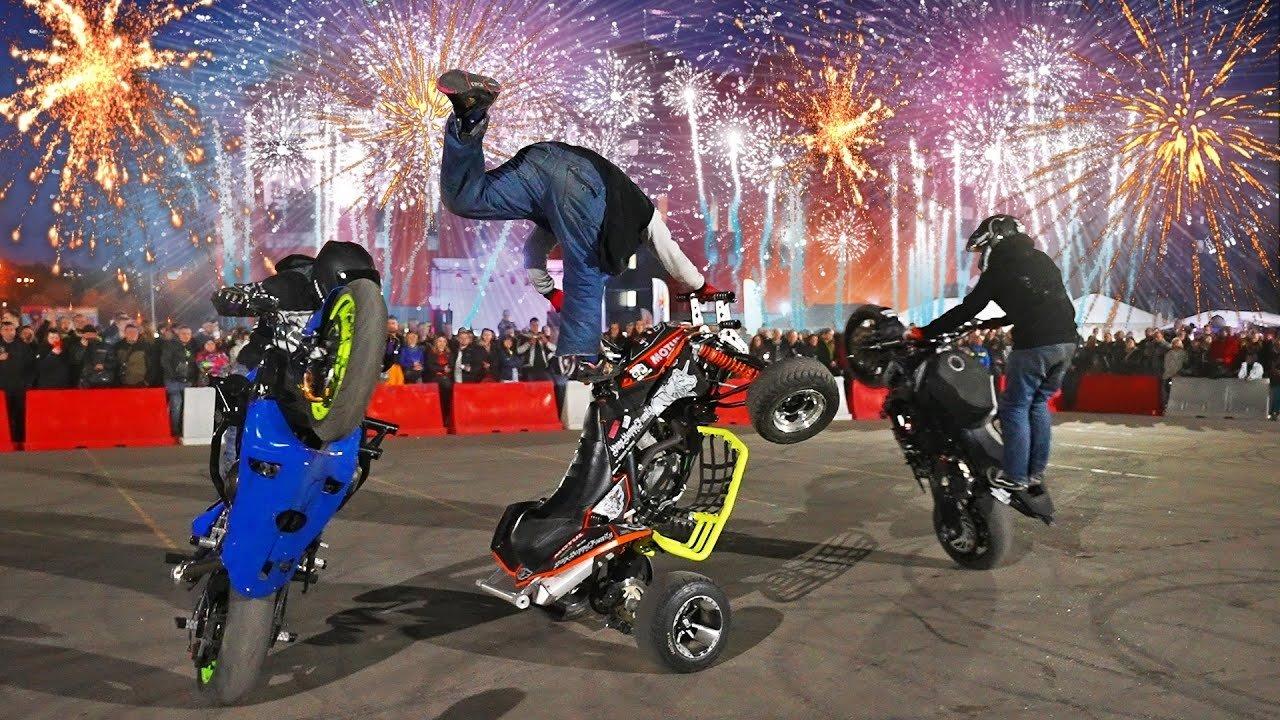
Then came the sound of an engine.
A deep roar echoed through the theater as the fictional Inferno Riders rolled into view, surrounded by dramatic lighting and a cloud of theatrical smoke.
Within seconds, the stage had been transformed into a high-octane arena.
The fictional America’s Got Talent-style stunt team delivered a spectacular performance combining motorcycle choreography, precision riding, acrobatics and fiery stage effects. The result was the kind of act designed to make viewers sit forward in their chairs and wonder what could possibly happen next.
But behind the intense expressions and roaring engines was a much funnier story.
There were helmet arguments.
There were misplaced gloves.
There was a mysterious squeaking boot.
And, at one point, one rider reportedly became more concerned about finding a sandwich than preparing for the biggest stunt of the night.

Meet the Inferno Riders
Inferno Riders are imagined as a professional stunt crew specializing in dramatic motorcycle performances.
Their fictional routine combines precision riding with theatrical choreography.
Instead of simply riding around the stage, the team moves as a coordinated unit.
One rider accelerates.
Another changes direction.
Two riders cross paths.
A third enters from the opposite side.
The performance gradually becomes faster and more complicated until the entire stage appears to be filled with movement.
The fiery visual theme gives the act its identity.
But the real skill is control.
The audience sees danger.
The riders see timing, distance and choreography.
Backstage Is Where the Real Comedy Begins
Before the show, the Inferno Riders were reportedly much less intimidating than they appeared onstage.
The riders spent much of their time checking equipment and preparing their costumes.
Helmets were inspected.
Gloves were checked.
Boots were tightened.
And then someone asked the question that always seems to appear before a major performance:
“Where are my gloves?”
The answer came from across the room.
“You’re wearing them.”
Everyone laughed.
The rider looked down.
They were, indeed, wearing the gloves.
Apparently, nerves can temporarily erase the ability to recognize your own equipment.
The Helmet Debate
The Inferno Riders’ fictional helmets were an important part of their performance look.
But getting everyone to agree on them was apparently difficult.
One rider wanted a completely black helmet.
Another wanted a brighter design.
A third wanted something with a dramatic flame pattern.
Someone suggested adding even more flames.
The costume designer reportedly responded:
“We already have a show called Inferno Riders.”
The group laughed.
The flame helmets survived the debate.
But the question of who had the coolest helmet remained unresolved.
Rehearsal Was Serious Business
The comedy disappeared when the team began rehearsing.
Motorcycle stunt performances require extraordinary concentration.
The riders need to know their routes.
They need to maintain precise spacing.
They need to understand when other riders will enter and exit.
And they need to respond immediately if something changes.
The fictional Inferno Riders therefore practiced their routine repeatedly.
First at slow speed.
Then at moderate speed.
Finally at performance speed.
Each sequence was broken down into smaller sections before the entire routine was assembled.
It was repetitive.
It was exhausting.
And it was absolutely necessary.
The Squeaky Boot Mystery
One rehearsal was interrupted by an unexpected sound.
Squeak.
Squeak.
Squeak.
Everyone stopped.
“What is that?”
Silence.
Then:
Squeak.
The team looked around.
Someone checked the motorcycle.
Someone checked the equipment.
Someone checked the stage.
Squeak.
Eventually, they discovered the culprit.
One rider’s boot was making the noise.
The entire group burst out laughing.
The rider tried walking again.
Squeak.
That only made things worse.
The boot was eventually fixed, but the incident became one of the team’s favorite backstage jokes.
Every time someone made an unexpected noise, another rider would simply say:
“It’s the boot.”
The Sandwich Situation
As the audition approached, the performers were understandably hungry.
One fictional rider reportedly disappeared for several minutes.
The others assumed they were checking equipment.
They were not.
They were looking for food.
When the rider finally returned, someone asked:
“Where were you?”
“Sandwich.”
That was the entire explanation.
The team laughed.
Then someone pointed out that they were about to perform a complicated motorcycle routine in front of a huge audience.
The rider shrugged.
“Exactly why I needed the sandwich.”
It was difficult to argue with that logic.
Showtime Approaches
As the performance drew closer, the mood changed.
The jokes became quieter.
The riders stretched.
The motorcycles were checked.
The stage was inspected.
The music was tested.
The theatrical effects were prepared.
The team reviewed the order of the routine one final time.
Everyone knew what was expected.
Now they had to deliver.
The stage manager gave the signal.
The riders moved into position.
The audience waited.
The Engines Roar
The theater suddenly filled with the sound of engines.
The audience gasped.
A spotlight swept across the stage.
The first Inferno Rider entered.
Then another.
Then another.
The riders moved in a carefully synchronized pattern.
The opening section was deliberately controlled.
It gave the audience time to understand what they were watching.
Then the pace increased.
The Inferno Begins
The fictional performance gradually introduced its signature fiery atmosphere.
Lights flickered.
Smoke filled parts of the stage.
Flame-colored effects appeared around the performance area.
The riders accelerated.
One crossed behind another.
Two riders moved toward each other before separating at the last second.
The audience reacted with a mixture of excitement and nervous laughter.
The judges leaned forward.
Every movement looked dangerous.
Every movement was carefully rehearsed.
The Most Dramatic Moment
Halfway through the routine, the music suddenly became quiet.
The riders slowed.
The audience waited.
One motorcycle moved into the center.
Another appeared from the side.
Then the two riders began moving around one another in a tightly synchronized pattern.
The pace increased.
The lighting intensified.
The theatrical flames appeared around them.
The audience erupted.
For several seconds, the stage looked like a scene from an action movie.
Then the riders separated and moved into the next sequence.
The Grand Finale
The final section was designed to be the biggest moment of the audition.
The music became louder.
The engines roared.
The riders moved faster.
The lighting flashed across the stage.
One rider completed a dramatic stunt sequence.
Another followed.
Then the entire team came together for the final formation.
They stopped almost simultaneously.
The engines quieted.
The riders removed their hands from the controls.
Silence.
Then the audience exploded with applause.
The Inferno Riders had completed their fictional audition.
The Judges’ Reactions
The fictional judges appeared stunned.
One immediately stood.
Another laughed in disbelief.
A third described the performance as a combination of precision and spectacle.
The judges understood that the act wasn’t simply about motorcycles.
It was about presentation.
The riders had created an entire world around their performance.
The engines provided energy.
The choreography provided suspense.
The lighting and theatrical effects created the visual drama.
Together, they created an experience.
Backstage, the Riders Celebrate
The moment the riders returned backstage, the serious expressions disappeared.
They hugged.
They laughed.
Someone immediately asked:
“Who has the water?”
Another replied:
“Check next to the sandwiches.”
Everyone laughed.
Then someone heard a squeak.
The entire group turned.
The rider with the troublesome boot looked down.
The boot squeaked again.
The backstage area erupted.
Apparently, some traditions survive even after a successful performance.
What the Audience Didn’t See
The spectacular final performance was only the visible part of the story.
The audience didn’t see the preparation.
They didn’t see the countless rehearsals.
They didn’t see the equipment checks.
They didn’t see the physical training.
They didn’t see the discussions about timing.
They didn’t see the moments when a sequence had to be repeated because someone entered half a second too early.
That’s the hidden work behind a stunt performance.
What looks spontaneous is usually the result of discipline.
What looks dangerous is carefully controlled.
And what looks effortless requires enormous effort.
Why Inferno Riders Could Become Fan Favorites
A talent-show audience remembers acts that create an immediate visual identity.
Inferno Riders certainly have one.
The motorcycles create spectacle.
The fiery theme creates drama.
The choreography creates suspense.
And the performers’ personalities create humor.
That last part is important.
The audience may first be impressed by the motorcycles, but they remember the people.
The riders aren’t simply fearless stunt performers.
They’re teammates.
They joke with one another.
They make mistakes.
They get hungry.
They lose gloves.
And apparently, they occasionally wear boots that refuse to stop squeaking.
The Final Backstage Laugh
After the audition, a fictional producer asked the group what they thought went best.
“The final stunt,” one rider said.
“The timing,” said another.
“The crowd reaction,” said a third.
Then someone added:
“The sandwich.”
Everyone laughed.
The producer asked whether the sandwich had been good.
The rider nodded.
“Excellent.”
And just like that, the Inferno Riders’ fictional night ended exactly as it had begun — with plenty of noise, plenty of excitement and plenty of humor.
Onstage, they looked fearless.
Backstage, they were simply a group of performers trying to keep track of helmets, gloves, boots and dinner.
The fictional AGT-style performance showed why stunt acts can be so compelling.
They combine athletic ability with theater.
They create suspense without sacrificing control.
And when the performers bring personality to the stage, the audience gets more than a stunt show.
They get a story.
For a few unforgettable minutes, the Inferno Riders turned the stage into an arena of speed, light and fire.
Then the engines stopped.
The applause faded.
And somewhere backstage, one mysterious boot squeaked one final time.
Squeak.
The Inferno Riders had officially left their mark.