By Entertainment News Staff
When Bello Nock appeared on America’s Got Talent in 2017, audiences quickly learned that the word “daredevil” was not being used as an exaggeration.
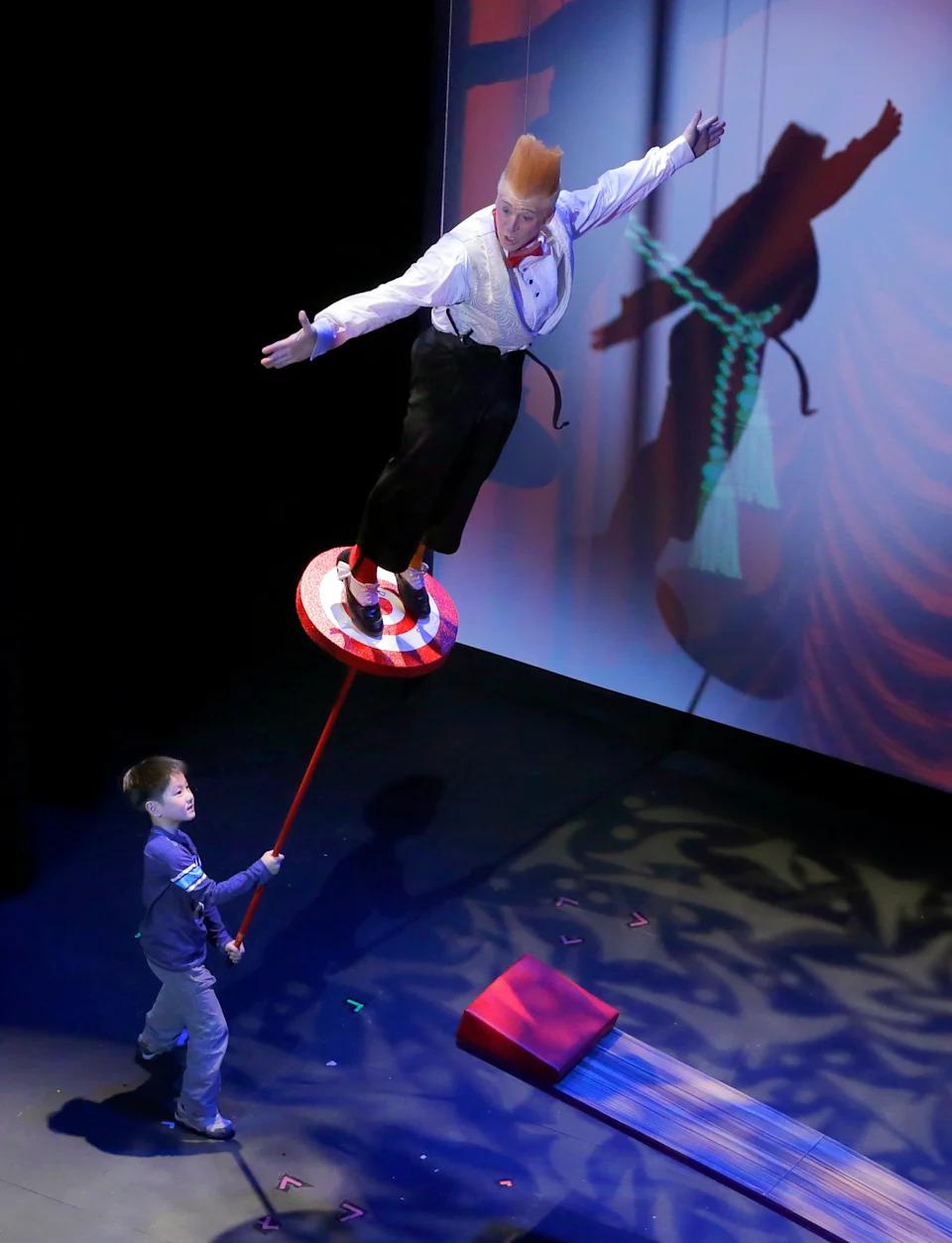
With his towering hair, white shirt, red bow tie and unmistakable clownish personality, Nock looked like someone who had wandered out of a classic circus poster and into the modern television era. Then he climbed a 37-foot swaying pole and turned what looked like an ordinary television stage into a high-wire playground.
NBC’s official AGT clip shows Nock performing his astonishing pole routine during the Season 12 auditions, while the show’s official YouTube channel described the performance as taking his talent to “new heights.”
But Bello Nock’s story began long before America’s Got Talent. He comes from a remarkable circus dynasty whose roots stretch back generations. His official biography describes him as a descendant of a family with more than nine generations of circus history, dating to 18th-century Switzerland.
And although audiences often associate him with terrifying stunts, there is another important word in his professional description:
comedian.

That combination—fearless daredevil and playful clown—is what makes Bello Nock so unusual.
A Circus Career That Started Young
Nock was introduced to performance as a child. CBS reported that he began performing at just 3 years old, while his family’s circus background eventually led him into a wide range of acrobatic and clowning skills.
By adulthood, he had become known for combining comedy with extraordinary physical feats.
TIME magazine profiled Nock in 2001 and highlighted his background as a seventh-generation circus performer, as well as his unusual combination of acrobatics and clowning. The magazine described how his physical strength allowed him to turn seemingly simple circus routines into elaborate comic performances.
That background is important because Bello wasn’t simply someone who learned a dangerous trick and brought it to television.
He was part of a circus tradition.
For him, physical performance, comedy and audience interaction were connected.
The Hair Arrives Before Bello Does
Of course, there is one feature of Bello Nock that deserves its own paragraph.
The hair.
His trademark hairstyle has become almost as recognizable as his stunts.
Ringling Bros. and Barnum & Bailey’s current website describes Nock as a performer known for his “iconic hair,” while his official website emphasizes his larger-than-life image.
Backstage, that hair creates an obvious question:
How does anyone keep it looking like that?
A fictionalized backstage exchange might go something like:
“Is the hair ready?”
“It was ready before I was.”
“Can we get it higher?”
“Absolutely not.”
That conversation is illustrative rather than a documented Bello Nock quote, but it captures the comedy of having a hairstyle that seems to have its own gravitational system.
The AGT Audition: Up the Sway Pole
When Nock auditioned for Season 12, he didn’t start with a gentle introduction.
He climbed.
And climbed.
And climbed.
According to the AGT fan archive, Nock scaled a roughly 37-foot, 2-inch-diameter swaying pole using his bare hands. Once at the top, he performed additional tricks before sliding down face-first.
NBC’s official footage captures the extraordinary height and balance involved.
For the audience, the sight was terrifying.
For Nock, it was another chapter in a lifetime of circus training.
For the production crew, however, the routine represented a giant logistical challenge.
Cameras needed to capture the height.
Lighting needed to work from multiple angles.
The stage needed to accommodate the apparatus.
And everyone needed to know exactly what was happening.
There is nothing casual about putting a giant swaying pole inside a television studio.
Backstage: Where Is the Pole?
Most contestants arrive backstage carrying a suitcase.
Bello Nock arrives with equipment that looks like it belongs outside.
That creates a funny contrast.
A singer might ask:
“Where can I warm up?”
A magician might ask:
“Where can I practice?”
Bello might ask:
“Where can we put the giant pole?”
Again, this is a humorous imagined scenario—not a documented conversation—but it illustrates just how different a daredevil’s backstage requirements can be.
The Costume Is Part of the Comedy
Nock’s appearance is deliberately theatrical.
The white shirt, red bow tie and black trousers help establish the classic clown persona before he performs a single stunt.
His hair adds another visual punch.
But the costume also serves a storytelling purpose.
The audience sees someone who looks playful.
Then that playful-looking character does something absolutely terrifying.
That contrast makes the performance more entertaining.
If a serious-looking athlete climbs a pole, audiences expect athleticism.
If a cheerful clown climbs a pole, the audience gets a completely different emotional experience.
The character makes the danger feel like comedy.
When the Stage Turns Into a Circus
Nock’s AGT journey demonstrated how difficult it can be to fit traditional circus skills into a television talent competition.
A circus has a large performance environment.
A television studio has cameras, lighting rigs, audience seating and limited space.
The performer has to adapt.
That means the production team has to adapt too.
The final performance might last only a few minutes, but the preparation behind it can be much more complicated.
The audience doesn’t see the measurements.
They don’t see equipment checks.
They don’t see camera rehearsals.
They see Bello climb.
And that’s exactly how it should be.
The Cannon Stunt
After his audition, Nock was not initially selected to continue.
But he later returned as a Wild Card quarterfinalist, giving audiences another opportunity to see him perform.
His Judge Cuts performance was particularly outrageous: he was launched from a cannon over a helicopter toward a target.
The official America’s Got Talent YouTube channel promoted the stunt with the question, “Will he make it?!”
It was the kind of performance that made viewers wonder whether the AGT production team had finally decided that ordinary stage acts were no longer enough.
The Funny Side of a Cannon
Imagine the backstage checklist.
Costume?
Ready.
Hair?
Ready.
Microphone?
Ready.
Cannon?
Unfortunately, also ready.
Again, that is a fictionalized joke, not a reported backstage exchange.
But it captures the absurdity of Bello’s television persona.
Most performers worry about forgetting lyrics.
Bello’s performance involves making sure an enormous stunt apparatus is ready to launch him across the stage.
It is difficult to imagine a more extreme version of “show business.”
The Wild Card Comeback
The Wild Card opportunity gave Nock another chance to prove himself.
And he chose the Wheel of Death.
The apparatus consisted of two large rotating wheels, with Nock performing inside and around the structure.
BuddyTV’s contemporary recap described the performance as an enormous rotating contraption and noted that Nock even appeared to have a frightening moment during the routine before completing it.
Another recap described his performance as one of the night’s most gripping moments, particularly because of the near fall.
The performance earned standing ovations from the judges.
But Nock ultimately did not advance to the semifinals.
The Wheel of Death
The name alone sounds like something a television producer would invent for dramatic effect.
But the Wheel of Death is a real circus apparatus requiring enormous strength, balance, timing and concentration.
Nock’s performance showed why circus danger acts are so difficult.
The wheel moves.
The performer moves.
The speed changes.
The audience reacts.
And the performer still has to maintain control.
That is not simply athleticism.
It is choreography performed under extreme conditions.
The Backstage Waiting Game
One of the funniest things about television production is that even the most dangerous performers spend a surprising amount of time doing something completely ordinary:
waiting.
Waiting for the camera.
Waiting for lighting.
Waiting for the previous act.
Waiting for the stage to be reset.
For Bello, that means going from “human projectile” to “person sitting backstage” in a matter of minutes.
It is a hilarious contrast.
One moment you’re preparing for a stunt that makes the audience scream.
The next someone asks:
“Would you like some water?”
“Yes, please.”
The danger may be enormous.
The backstage snack remains completely normal.
The Clown Who Can Terrify an Audience
Nock’s great skill is knowing how to move between comedy and danger.
His official website describes his work as a combination of “endearing comedy” and “jaw-dropping daredevil stunts.”
That combination explains his longevity.
A pure daredevil can impress an audience.
A pure clown can make an audience laugh.
Bello does both.
He can make people laugh while standing on something incredibly high.
He can make a dangerous stunt feel playful.
And he can make the audience forget, for a moment, just how difficult the skill actually is.
The Family Circus Tradition
Nock’s career is also deeply connected to his family.
His official biography says his family has produced circus and thrill-show performers for generations.
That tradition continued into the next generation.
His daughter Annaliese later appeared on America’s Got Talent, and Bello and Annaliese eventually performed together as a father-daughter daredevil team.
They later represented America’s Got Talent on Britain’s Got Talent: The Champions, taking on the Wheel of Death together. ITV described the apparatus as a 50-foot-high rotating wheel.
For a family whose professional history revolves around circus performance, the stage is quite literally a family business.
The Father-Daughter Version
When Bello and Annaliese performed together, the emotional stakes changed.
A solo daredevil is responsible for himself.
A father performing with his daughter has another layer of trust.
Their AGT Season 15 journey included a Wheel of Death performance, and their act was later featured internationally.
The family connection made their performances even more compelling.
It also creates another funny backstage possibility:
Dad:
“Are you ready?”
Daughter:
“Yes.”
Dad:
“Are you sure?”
Daughter:
“Dad, you’ve asked me that five times.”
Dad:
“Good. I’m asking a sixth.”
Again, that dialogue is fictionalized for humor, but the basic idea of family members checking on one another before dangerous performances is easy to understand.
Bello’s Career Beyond AGT
America’s Got Talent is only one chapter in Nock’s career.
His official website says he has performed in more than 20,000 live shows for more than 100 million audience members worldwide.
He has also received Guinness World Records recognition and was inducted into the Circus Ring of Fame, according to his biography.
His career has included appearances at major venues and spectacular stunts involving tightropes, helicopters and towering structures.
That makes AGT less a beginning than another platform for a performer who had already spent decades developing his craft.
A Modern Circus Legend Returns
Bello’s connection to the circus remains active.
In July 2026, Ringling Bros. and Barnum & Bailey announced that Nock would return as a special guest performer for limited engagements in Dallas and Fort Worth. The announcement highlighted his recognizable hair, comedy, and gravity-defying stunts.
That return is a fitting reminder that the appeal of classic circus performance has not disappeared.
It has simply found new stages.
Television.
Social media.
Live theater.
Modern circus productions.
And, occasionally, a giant Wheel of Death.
The Hair, the Humor and the High Wire
Perhaps the most entertaining thing about Bello Nock is that he never seems to fit neatly into one category.
He is a clown.
He is a daredevil.
He is an athlete.
He is a circus performer.
He is a comedian.
And he is part of a family tradition stretching back generations.
On America’s Got Talent, those identities came together perfectly.
The hair made audiences laugh.
The costume made them curious.
The jokes made them comfortable.
Then the stunt made them terrified.
That formula is simple, but extraordinarily difficult to execute.
What Happens When the Cameras Stop?
The audience sees Bello at the top of a pole.
They see him fly through the air.
They see the Wheel of Death spinning.
They hear the judges scream.
Then the cameras cut.
What remains is the performer himself.
Someone who has spent a lifetime learning how to make impossible things look entertaining.
Someone who understands that comedy can make fear easier to handle.
Someone who knows that the audience needs both a reason to laugh and a reason to hold its breath.
And perhaps someone who has to spend the next ten minutes fixing his enormous hair.
The Real Magic of Bello Nock
Bello Nock’s AGT story is ultimately about much more than one audition or one stunt.
It is about the survival of a performance tradition.
It is about a circus family adapting to modern television.
It is about combining comedy with extraordinary athletic ability.
And it is about understanding that danger alone is not entertainment.
Personality is entertainment.
The audience remembers the stunt because Bello makes it memorable.
They remember the hair because he makes it part of the character.
They remember the jokes because he makes the frightening moments fun.
And they remember the performer because he makes an enormous stage feel like a circus ring.
Behind the scenes, the reality is undoubtedly much less glamorous: equipment checks, rehearsals, costume adjustments, camera marks, long waits and constant preparation.
But once Bello walks onto the stage, all of that disappears.
There is only the clown.
The daredevil.
The enormous hair.
And whatever impossible thing he has decided to do next.
That’s the Bello Nock formula—and after decades of circus history, it is still very much IncrediBello.
Editor’s note: This feature is based on documented information about Bello Nock’s circus career, America’s Got Talent Season 12 appearances, Wild Card return, Wheel of Death performance, family history, and later work. The humorous backstage conversations and scenarios are fictionalized for entertainment and are not presented as verified quotations or private incidents.