By Entertainment News Staff
There are America’s Got Talent performances that make audiences clap.
There are performances that make them cry.
And then there are performances that make everyone in the theater sit completely still and think, “Please don’t let anything go wrong.”
That was the special talent of Deadly Games, the knife-throwing act associated with Alfredo and Anna Silva. Their performances combined precision, danger, theatricality, and a level of trust that made even experienced performers look nervous.
The duo first appeared on America’s Got Talent in Season 11, where they reached the semifinals. They later returned for America’s Got Talent: The Champions, earning Heidi Klum’s Golden Buzzer and advancing to the finals.
Onstage, everything looked terrifyingly serious.
Backstage, however, the atmosphere surrounding a danger act could be surprisingly ordinary: costume checks, microphones, rehearsals, camera blocking, equipment inspections, nervous jokes, and the eternal television-production question:
“Where did we put that?”
For Deadly Games, the stakes were obviously much higher than for a singing act. Yet the contrast between their terrifying stage persona and the everyday backstage world is exactly what made the story so fascinating.
A Duo Built on Trust
Deadly Games grew out of the partnership between Alfredo Silva, a sixth-generation circus performer, and Anna Silva, who had a background in ballet and choreography. According to the AGT fan archive, the pair combined Anna’s dance experience with Alfredo’s interest in increasingly dangerous performance skills, developing Deadly Games in 2009.
That history explains why their performances looked so precise.
Every movement had a purpose.
Every step had to be calculated.
Every body position mattered.
For viewers, the spectacle was the knife flying through the air.
For performers, the real foundation was trust.
Anna had to trust Alfredo.
Alfredo had to trust his training.
And both had to trust the rehearsal process.
One tiny mistake in a dance routine might mean restarting a sequence.
In a dangerous act, precision matters for much more serious reasons.
Backstage, the First Rule Is Probably “Don’t Touch Anything”
Most AGT contestants can leave props lying around for a moment.
A comedian can put down a microphone.
A magician can set down a deck of cards.
A singer can leave a water bottle beside a chair.
A danger act has a very different relationship with equipment.
The safest backstage joke practically writes itself:
“Has anyone seen the knives?”
Everybody freezes.
Then:
“Just kidding. They’re exactly where they’re supposed to be.”
That kind of humor is obviously illustrative rather than a documented private Deadly Games conversation. But it captures the strange reality of preparing an act built around dangerous-looking equipment inside a busy television studio.
Organization isn’t glamorous.
It is essential.
The Audience Saw Fear; The Crew Saw Preparation
When Deadly Games performed on America’s Got Talent, the audience saw a wall, a target, knives, and Anna standing in positions that made viewers wonder how anybody could possibly remain calm.
The backstage process was much more methodical.
Stage areas had to be prepared.
Camera operators needed their positions.
Lighting cues had to be confirmed.
Production teams had to know where performers would stand.
The act also needed room to move safely.
This is one of the least visible parts of television entertainment: the audience experiences a few minutes of apparent chaos, while the crew experiences a carefully organized system.
The illusion of danger depends on the absence of actual chaos.
The AGT Audition That Made Everyone Nervous
Deadly Games’ Season 11 audition immediately established their identity.
Alfredo threw knives toward Anna as she stood against a target, changed positions, and even performed the routine with flaming knives. The judges voted to send them onward.
It was the sort of performance where the room becomes quieter instead of louder.
That is a remarkable achievement.
Even though AGT audiences are accustomed to spectacular acts, danger performances create a different reaction.
People aren’t only wondering whether the performers are talented.
They’re wondering what happens next.
That tension became one of Deadly Games’ greatest strengths.
The Funny Reality of Rehearsals
A television rehearsal can be very repetitive.
Do the entrance.
Stop.
Change the camera.
Reset.
Try again.
Check the lights.
Reset.
Try again.
For Deadly Games, that repetition was especially important because every movement had to be precise.
The serious nature of the act could make ordinary backstage problems seem strangely funny.
Imagine Anna getting into position while someone behind the curtain says:
“Wait, the camera isn’t ready.”
Everyone relaxes.
They reset.
Again.
Then:
“Actually, we’re ready.”
Back into position.
That is the strange rhythm of television.
The audience sees one flawless performance.
The performers and crew experience the same sequence dozens of times.
A Technology-Lab Twist
When Deadly Games returned for America’s Got Talent: The Champions, they didn’t simply repeat their original act.
Their routine incorporated a technology-lab theme and included knives, a rotating frame, a shattered martini glass, and a crossbow element. Heidi Klum ultimately gave the duo her Golden Buzzer, sending them directly to the finals.
The addition of technology made their act feel more like a movie sequence than a traditional circus performance.
It also meant even more technical coordination behind the scenes.
More props.
More lighting.
More camera planning.
More timing.
And, presumably, more people asking whether everything was securely attached.
When the Judges Became Part of the Act
The danger level increased dramatically during the Champions finals.
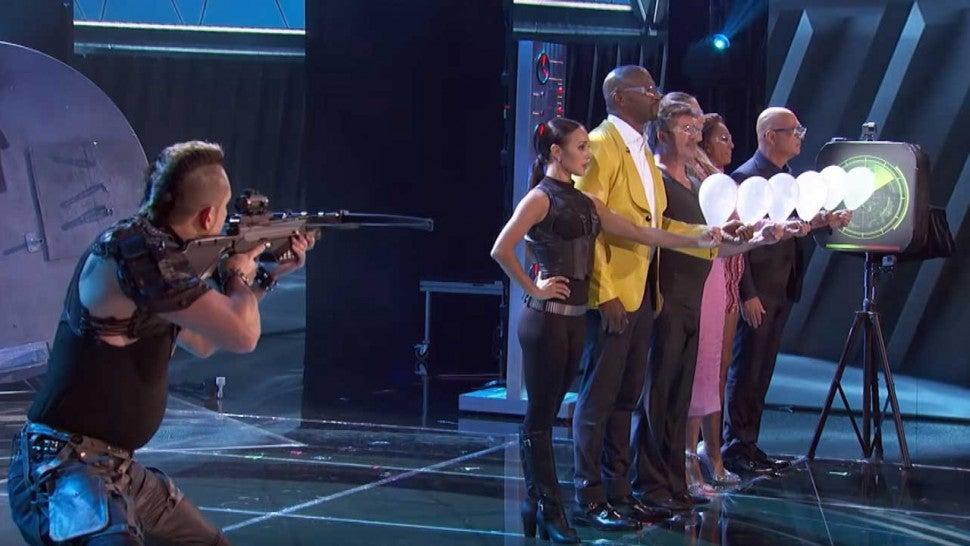
Deadly Games involved the four judges in a crossbow balloon stunt. Heidi Klum, Howie Mandel, Simon Cowell, and Mel B each took part in the setup while Alfredo fired at balloons. Entertainment Tonight described the moment as one of the show’s most nerve-racking stunts, with the arrow successfully bursting the balloons in sequence.
For the judges, this was no longer simply a case of watching from a comfortable chair.
They were suddenly part of the routine.
The humor came partly from their reactions.
Everyone was trying to look brave.
Everyone was also clearly aware of where the crossbow was pointing.
That combination created a memorable television moment.
The Funniest Part: Everybody Wants to Look Calm
There is something naturally funny about people trying very hard to look relaxed while standing near an obviously dangerous stunt.
Simon Cowell might make a joke.
Howie Mandel might laugh nervously.
Heidi might smile.
Mel B might try to maintain composure.
Meanwhile, somewhere behind the scenes, a producer is probably thinking:
“Please let this go exactly as planned.”
The audience experiences the suspense.
The production crew experiences the responsibility.
The performers experience the concentration.
Those three perspectives are completely different, even though they happen in the same room.
A Performance That Went Wrong During Rehearsal
The danger of Deadly Games was not simply theatrical.
A recap of their Champions appearance noted footage of a performance going wrong during rehearsal, making the eventual live performance even more nerve-racking for viewers.
That detail is important because it illustrates why rehearsal exists.
The goal isn’t to prove that something can never go wrong.
The goal is to identify problems, refine the procedure, and make the final performance as controlled as possible.
For audiences, rehearsal footage can be shocking.
For professionals, it can be part of the process of improving a complicated act.
Keeping the Mood Light
Danger acts have to take safety seriously.
But that doesn’t mean every minute backstage has to feel tense.
In fact, humor can be useful.
A performer jokes with a camera operator.
Someone complains about a costume.
A stagehand makes a harmless comment.
The team laughs.
Then everybody goes back to work.
That balance—serious preparation mixed with everyday humor—is a familiar part of professional performance life.
Deadly Games’ dramatic stage image therefore hides a more relatable reality.
They still had to wait for camera cues.
They still had wardrobe adjustments.
They still had rehearsals that ran long.
They still had to listen to stage managers.
The difference was that their props made everyone’s attention a little more intense.
The Relationship Behind the Performance
The most compelling part of Deadly Games was never simply the knives.
It was the relationship between the performers.
Anna had to remain committed to her movements even when the audience was screaming.
Alfredo had to remain focused while performing around a person he cared about.
Their act was built on mutual confidence.
That confidence is what transformed something frightening into something that could be performed repeatedly.
The result was not random danger.
It was choreography.
When the Stage Becomes a Story
Deadly Games understood that a great danger act needs more than difficult skills.
It needs storytelling.
Their technology-lab presentation on The Champions gave the routine a setting.
The rotating frame created visual drama.
The crossbow finale added suspense.
The judges’ participation created emotional investment.
Every element served the same purpose: keep the audience wondering what would happen next.
The technical challenge was making all of those pieces appear seamless.
Life After the Original Duo
The story of Deadly Games later became more complicated.
NBC reported in 2025 that Anna returned to America’s Got Talent under her maiden name, Anna Saranina, explaining that her professional and personal circumstances had changed since her earlier Deadly Games appearances.
The AGT archive also records that Alfredo later continued performing the Deadly Games act with other partners following the end of his personal and professional relationship with Anna.
That development gives the original Deadly Games performances an additional historical significance.
Fans remember Alfredo and Anna as the duo who turned knife throwing into a theatrical AGT spectacle.
But the performers themselves continued on separate professional paths.
Why Fans Still Remember Deadly Games
Danger acts have always occupied a special place in talent competitions.
A singer can miss a note.
A dancer can miss a step.
A magician can have a trick fail.
But a performer handling knives or crossbows carries a different kind of tension.
That tension is exactly what Deadly Games understood.
They didn’t simply demonstrate a skill.
They created suspense.
They made viewers hold their breath.
And occasionally, they made everyone laugh because the judges looked just as nervous as the audience.
Behind the Fearless Image
The greatest surprise about Deadly Games may be how ordinary the backstage world can be.
The performers still needed costume checks.
The crew still needed camera positions.
Someone still had to make sure the stage was ready.
Rehearsals still required repeated resets.
And people still needed to laugh.
The knives may have been extraordinary, but the work behind them was built on familiar principles: preparation, discipline, teamwork, communication, and trust.
That is what allowed Deadly Games to create some of the most memorable danger performances in America’s Got Talent history.
The Legacy of Deadly Games
Deadly Games’ journey from Season 11 semifinalists to The Champions finalists demonstrated how a distinctive talent can evolve.
Their original AGT appearance introduced audiences to Alfredo and Anna’s combination of dance and precision knife throwing. Their later return expanded that concept with new technology, moving targets, crossbows, and even participation from the judges.
But perhaps the funniest truth about their performances is that the most frightening part happened on television.
Backstage, there was probably much more organization than chaos.
Much more repetition than improvisation.
And much more laughter than viewers might expect.
The audience saw knives flying.
The crew saw marks on the floor.
The judges saw danger.
The performers saw years of practice.
And somewhere between all of those perspectives was the real Deadly Games story: a team capable of turning an extraordinarily risky-looking skill into polished entertainment while keeping the human side of performance alive.
That’s why the act remains memorable.
Deadly Games didn’t just make audiences gasp.
They made them laugh, stare, cheer, and hold their breath—all in the space of a few minutes.
And that may be the most impressive trick of all.