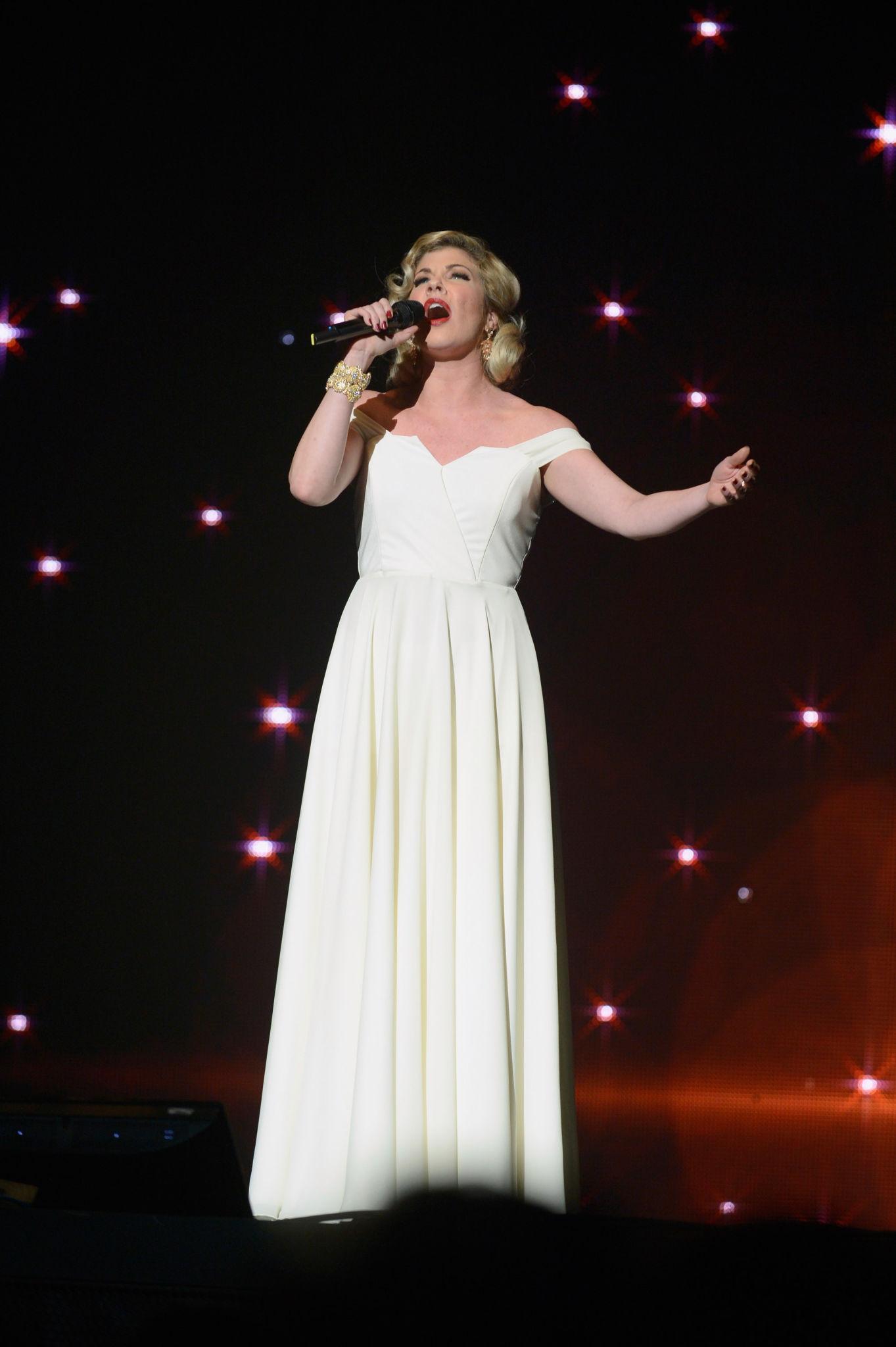
By Entertainment News Staff
When Emily West walked onto the America’s Got Talent stage in 2014, she wasn’t a complete newcomer to the music business. She had already spent years building a career as a singer and songwriter, including time in Nashville, a publishing and record deal, and country singles before finding herself at a crossroads. Her AGT journey became a major second act: a chance to introduce herself to a huge audience in a completely different way and show that a career can have more than one chapter.
West eventually finished second in Season 9, behind magician Mat Franco, while AcroArmy placed third.
For viewers, her AGT run became a showcase of dramatic vocals and ambitious song choices. She delivered memorable performances including “Nights in White Satin,” “Chandelier,” and “True Colors,” the latter as a duet with Cyndi Lauper during the finale.
But the television stage only showed part of the story.
Behind the curtain were rehearsals, microphones, hair and makeup, wardrobe changes, long waits, last-minute adjustments, emotional highs and plenty of ordinary backstage moments that made the glamorous television experience feel surprisingly human.

A Second Chance With a Big Voice
West’s background made her AGT journey particularly compelling.
She moved to Nashville at 18 and developed her skills performing in local clubs. She eventually landed a publishing deal and record-label deal and released three country singles. Her duet with Keith Urban, “Blue Sky,” also earned an Academy of Country Music Award nomination.
That meant she arrived at America’s Got Talent with experience.
She knew what it meant to perform.
She knew how recording worked.
She knew how difficult the music business could be.
But television competition was another world entirely.
There are cameras everywhere.
Producers give instructions constantly.
A song might need to be shortened.
A performance may need to be repeated because a camera missed a shot.
And the singer who is used to controlling her own show suddenly has to work inside someone else’s schedule.
That contrast probably created plenty of backstage comedy.
A fictionalized exchange might have gone like this:
“Emily, we’re ready.”
“Great.”
“Actually, hold on.”
“Okay.”
“Now we’re ready.”
“Are you sure?”
“No.”
That conversation is illustrative, not a documented quote, but anyone familiar with television production knows the feeling.
The Subway Ride That Became an AGT Journey
West’s path to AGT reportedly included an adventure that was almost comical in itself.
A 2015 press release said she traveled to New York, got lost on the subway, and ended up auditioning for America’s Got Talent. It described the show as an opportunity for her to demonstrate vulnerability and versatility to a wide audience.
Getting lost on the New York subway is practically a rite of passage.
Doing it while trying to reach one of the biggest auditions in America adds another level.
One can imagine her looking at a subway map and thinking:
“I came here to sing, not solve a transportation puzzle.”
Again, that is playful invention, not a reported quote.
But it captures something charming about the beginning of her AGT story: a major career opportunity started with an extremely ordinary urban problem.
The Audition Room Is a Different World
The America’s Got Talent Season 9 auditions took place in a production environment filled with performers, judges, crew members and long days of waiting. TV Guide’s behind-the-scenes report from the season described judges working through large numbers of acts and joked about how long days could make them a little loopy. The article also noted that the judges saw many different kinds of talent and sometimes stayed late debating which acts should move forward.
For a contestant, that means the waiting room could be almost as memorable as the stage.
You might meet a dancer.
Then a magician.
Then a comedian.
Then someone who has trained for years to balance on a stack of chairs.
And somewhere in the middle is a singer trying to decide whether her voice sounds warmed up.
The Makeup Chair Becomes a Second Stage
For a singer preparing for television, makeup and hair are not simply cosmetic details.
They are part of the production.
Lighting can change how a face looks.
A camera can exaggerate small details.
A hairstyle can look very different under stage lights.
Getty Images later captured West preparing backstage during the America’s Got Talent Live! All Stars Tour, including a candid photograph of her applying eye makeup in a dressing room surrounded by coffee cups, water bottles and makeup supplies.
That image offers a perfect reminder that the polished television performer and the person backstage are the same person.
One minute she is preparing for a major show.
The next she is checking eyeliner in a mirror while coffee sits nearby.
Hollywood glamour has a very ordinary side.
The Hair Has to Survive the Song
West’s glamorous style became part of her AGT identity.
Her performances often featured elegant gowns, dramatic lighting and the classic image of a powerhouse vocalist.
But glamorous hair has one enemy:
movement.
A singer may not be doing a dance routine, but emotional singing can involve plenty of movement.
Arms rise.
Heads turn.
Hair moves.
Microphones shift.
And suddenly the stylist’s carefully arranged hairstyle is participating in the performance too.
That can create the kind of backstage humor performers understand immediately.
“How’s the hair?”
“Perfect.”
“What about now?”
“Still perfect.”
“What about after that note?”
Silence.
Then laughter.
The exchange is fictionalized, but the practical concern is real: televised performers have to think about everything the camera can see.
Finding Her Voice Again
One reason West’s story resonated was that her AGT performances allowed her to redefine herself.
A press release discussing her post-AGT music specifically highlighted her reinterpretations of “Nights in White Satin,” “Chandelier,” and “True Colors,” as well as original songs.
This was more than just a list of songs.
It represented a new artistic direction.
Instead of being remembered only for her earlier country career, West was now presenting herself as a dramatic vocalist capable of working across styles.
On television, that evolution looked effortless.
Behind the scenes, it would have meant serious rehearsal.
“Nights in White Satin” and the Big Transformation
West’s performance of the Moody Blues classic “Nights in White Satin” became one of the signature performances of her AGT season. Contemporary coverage described the performance as stunning, and the image of West singing beneath a giant chandelier became one of the visual moments associated with her run.
The set transformed the song into something theatrical.
That meant West wasn’t just singing.
She was acting.
She was using the stage.
She was responding to the lighting.
She was working with the atmosphere created by the production.
The audience saw the finished picture.
Backstage, someone still had to make sure the microphone was working.
The Microphone Check Nobody Sees
Before a major vocal performance, a sound engineer needs to make sure the microphone works correctly.
A singer may be asked to sing a few lines.
The engineer adjusts levels.
The singer repeats the line.
Then again.
Then one more time.
The audience never sees this.
For the performer, it can feel endless.
A humorous imaginary version:
“One more for sound.”
“I just did one.”
“I know.”
“Why another?”
“Because television.”
That isn’t a real Emily West exchange. It simply illustrates the repetitive technical work behind a polished live performance.
The Judges Were Paying Attention
West benefited from strong support from the judging panel throughout her run.
Parade reported before the finale that Heidi Klum was rooting for West, while the judges had already been discussing which finalists they believed could win.
That kind of support matters psychologically.
When an artist hears a judge say they believe in her, the pressure doesn’t disappear—but it can become easier to handle.
The competition remains.
The audience still votes.
But the performer knows somebody on the judging panel is paying attention.
Backstage at Radio City Music Hall
The Season 9 live shows and finale were held at Radio City Music Hall in New York City.
That setting added another layer of excitement.
Radio City isn’t simply a theater.
It is one of the most recognizable performance venues in the United States.
Performing there means dealing with huge expectations and an enormous production.
Backstage, though, the same ordinary problems remain.
A dress zipper still has to work.
A microphone still needs testing.
A singer still needs water.
A stylist still has to fix hair.
The glamorous venue doesn’t eliminate practical problems.
It simply puts them inside a more famous building.
Cyndi Lauper Joins the Journey
West’s AGT story reached an especially memorable point during the finale when she performed “True Colors” with Cyndi Lauper. MusicRow reported the duet as one of the night’s major moments and noted that Lauper had previously encouraged West during a Celebrity Apprentice appearance.
For West, it was an extraordinary full-circle moment.
For the production crew, it meant another artist had to be integrated into an already complicated finale schedule.
There would be rehearsals.
Microphone checks.
Camera rehearsals.
Wardrobe.
Lighting.
Timing.
And all the other details that go into a high-profile television duet.
The audience saw two singers sharing the stage.
The crew saw a carefully coordinated production.
And Then Came the Finale
West ultimately finished second to Mat Franco.
The final result was announced on September 17, 2014, with Franco taking the championship and West earning runner-up honors.
It was a bittersweet ending.
She had come incredibly close to winning.
But second place did not erase the impact of what she had accomplished.
The show had introduced her to a massive new audience.
It had given her a chance to reinvent herself.
And it had created opportunities for new music and live performances.
The All Stars Tour and Life Beyond the Competition
After the season, West continued working professionally and appeared in America’s Got Talent Live! The All Stars Tour. Getty Images photographed her backstage during the 2015 tour, including candid moments in dressing rooms and interactions with young fans.
Those images tell their own story.
The television competition was over.
But the performer was still working.
The dresses were still there.
The makeup was still there.
The stage was still there.
The only difference was that now audiences had already seen her journey.
The Funny Side of Touring
Life on a touring show can create a new kind of backstage comedy.
A performer has to travel.
Hotels become temporary homes.
Dressing rooms become temporary offices.
Coffee becomes a survival strategy.
And the makeup bag becomes one of the most important pieces of luggage.
One Getty Images photograph from West’s 2015 touring period shows exactly that sort of behind-the-scenes environment: makeup supplies, drinks and an intimate dressing-room setup rather than the glamorous stage audiences saw later.
It is a useful reminder that entertainment careers are built from ordinary routines repeated over and over again.
Fans Become Part of the Story
Another backstage Getty photograph shows West posing with a young fan during the tour.
Moments like that are not part of a judge’s critique or a televised elimination.
They are simply human interactions.
For a performer, seeing a fan’s reaction can be one of the most rewarding parts of continuing after a talent competition.
The show ends.
The cameras stop.
But the connection with the audience can continue.
Why Emily West’s Story Still Stands Out
What made Emily West memorable was not simply that she had a powerful singing voice.
It was the combination of experience, vulnerability and reinvention.
She had already experienced professional success.
She had already experienced disappointment.
Then she stepped onto America’s Got Talent and rebuilt her artistic identity in public.
That makes her journey different from the story of a complete beginner discovering talent for the first time.
West already knew the business.
AGT gave her another opportunity to tell the world who she was.
The Real Story Behind the Glamour
The audience saw beautiful gowns, giant chandeliers, emotional vocals and a duet with Cyndi Lauper.
Behind all that were less glamorous moments:
Long rehearsals.
Repeated microphone checks.
Makeup touch-ups.
Hair adjustments.
Waiting for cameras.
Wardrobe changes.
Subway directions.
Coffee cups.
And probably at least one moment when somebody asked:
“Are we ready?”
Only to hear:
“Almost.”
That is show business.
The spectacle exists because ordinary people spend enormous amounts of time making complicated things look effortless.
A Runner-Up Who Won a New Audience
Emily West didn’t take home the Season 9 championship. Mat Franco did.
But West’s AGT journey gave her something that a trophy cannot fully measure: a new audience.
She entered the competition with a history.
She left with a new identity.
She had shown that songs could be reimagined.
She had demonstrated dramatic range.
She had shared a stage with Cyndi Lauper.
And she had turned a second chance into one of the strongest vocal runs of her season.
The Legacy of Emily West
Today, fans who remember Season 9 often recall Mat Franco’s historic victory.
But they also remember Emily West.
They remember the voice.
They remember the gowns.
They remember “Nights in White Satin.”
They remember “Chandelier.”
They remember “True Colors.”
And they remember a singer who seemed to grow more confident with every performance.
The behind-the-scenes story is perhaps even more charming.
Because beneath the glamorous television image was a working performer dealing with the same practical challenges as everyone else—finding the right stage entrance, surviving production delays, making sure the microphone worked and trying not to ruin the hair before the cameras started rolling.
Emily West’s AGT story is therefore not simply about coming in second.
It is about proving that a career can be rebuilt.
A missed opportunity does not have to be the final chapter.
Sometimes it is simply the reason the next chapter becomes more interesting.
And sometimes, after getting lost on the subway, walking onto a talent-show stage and singing your heart out, you discover that the detour was actually the destination.