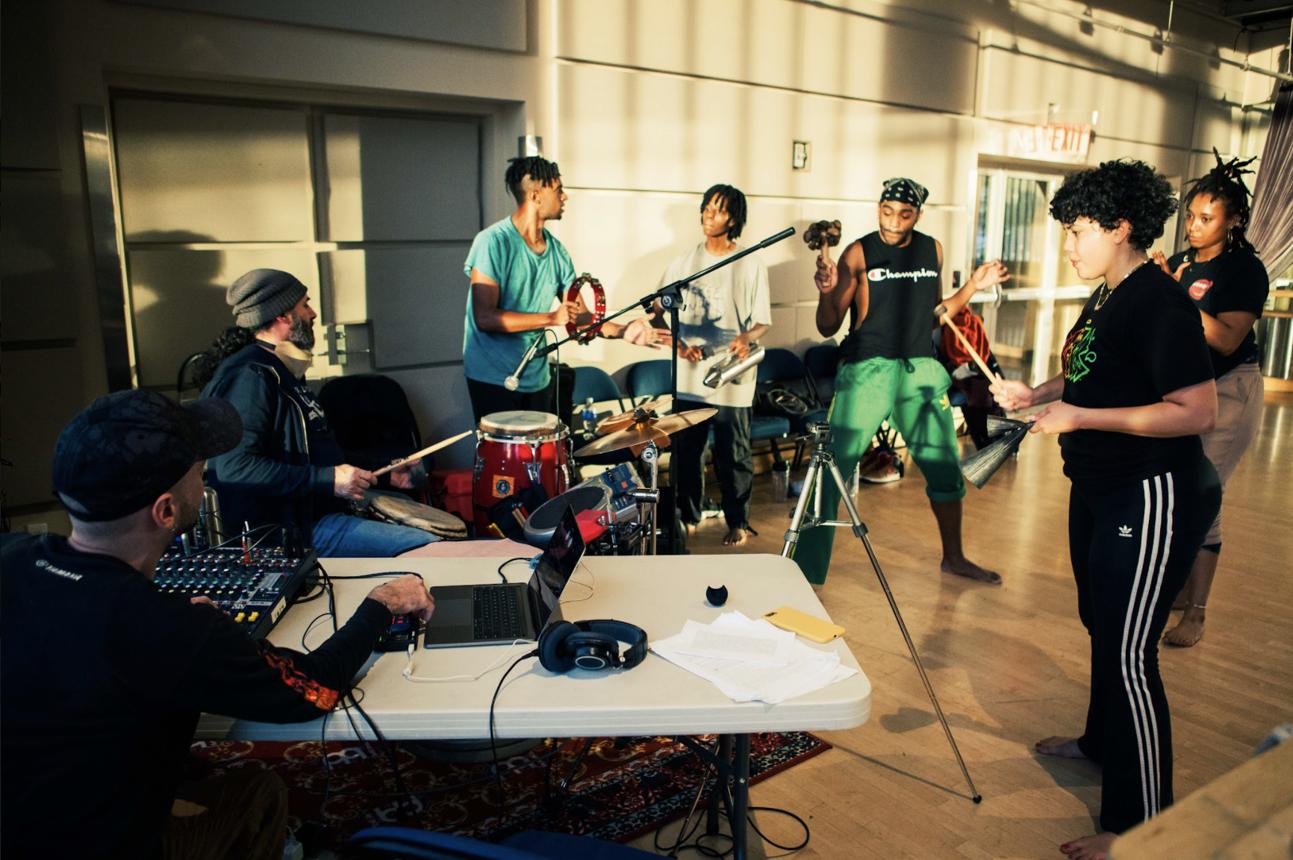
The first thing you should know about Golden Rhythm is that absolutely nothing about the group’s backstage preparation was quiet.
That may sound strange for a musical act, but it was true.
Before the fictional America’s Got Talent performance that would eventually end with a Golden Buzzer-style celebration, the members of Golden Rhythm were already making enough noise to make the production crew wonder whether the audition had accidentally started early.
There were drums.
There were hand claps.
There were foot stomps.
There were singers warming up.
And, at one point, there was an argument over a tambourine.
The tambourine eventually won.
Yet when the lights came on and Golden Rhythm stepped onto the stage, all that chaos suddenly transformed into a tightly choreographed performance combining percussion, vocals and dance.
What happened next was the kind of television moment talent shows are built for.

A Group Built Around One Simple Idea
Golden Rhythm was created by a fictional group of young performers who shared one belief:
Music doesn’t always need traditional instruments.
The group combined body percussion, hand drums, buckets, shakers, claps, stomps and vocals to create a rhythmic performance designed to make audiences feel the beat before they even realized they were dancing.
Their members came from different musical backgrounds.
Some were drummers.
Some were singers.
Some were dancers.
One member had reportedly started playing percussion using kitchen containers.
Another learned rhythm by copying songs on school desks.
The result was unusual.
And loud.
Very loud.
The First Rehearsals
Golden Rhythm’s rehearsals were never ordinary.
A typical session began with someone counting:
“One, two, three, four!”
Then 15 different sounds happened almost simultaneously.
The group’s leader would stop.
“Again.”
They would start.
Someone would clap too early.
“Again.”
Someone would hit the wrong drum.
“Again.”
Someone would accidentally knock over a bucket.
“Again.”
After several attempts, everyone would laugh.
Then they would try again.
That persistence eventually turned their unusual collection of sounds into a polished performance.
The Bucket That Became Famous
One of Golden Rhythm’s most important instruments was something that didn’t look remotely musical.
A plastic bucket.
The group used it as a bass drum.
The bucket produced a surprisingly powerful sound.
The problem was keeping it in place.
During one rehearsal, a performer hit it so hard that the bucket moved several feet across the floor.
Everyone stopped.
The drummer looked at it.
The bucket looked innocent.
The group leader finally said:
“Maybe we should put the bucket on a diet.”
Nobody knew exactly what that meant.
Everyone laughed anyway.
Audition Day Begins
On the morning of the fictional AGT audition, Golden Rhythm arrived early.
Very early.
They needed time to set up their instruments.
There were drums.
Buckets.
Shakers.
Microphones.
Stools.
Cables.
And enough equipment to make the backstage area resemble a tiny traveling percussion festival.
A production assistant looked at the equipment list and asked:
“How many people are in this act?”
The group leader answered:
“Eight.”
The assistant looked at the pile.
“It looks like 80.”
The Tambourine Crisis
The biggest backstage emergency involved a tambourine.
One of the members couldn’t find it.
Everyone searched.
Under chairs.
Inside equipment bags.
Behind speakers.
Near the dressing rooms.
Nothing.
The group began to panic.
Then someone discovered the tambourine hanging from the missing performer’s own backpack.
The performer stared at it.
“Oh.”
Everyone laughed.
Golden Rhythm’s rule for audition day quickly became:
If something disappears, check whether you’re already carrying it.
Sound Check
Sound check was complicated.
Traditional singers can stand at a microphone.
Golden Rhythm had percussion instruments spread across the stage.
Every drum needed its own microphone.
Every microphone needed testing.
Every performer needed to know exactly where to stand.
The sound engineer asked for one instrument at a time.
Drum.
Clap.
Bucket.
Shaker.
Voice.
Then the entire group.
When everyone played together, the studio shook.
A crew member jokingly asked whether the building was supposed to move.
The group leader laughed.
“Only slightly.”
The Performance Begins
When Golden Rhythm’s name was announced, the audience applauded.
The performers walked onto the stage.
They stood silently.
For a moment, nobody moved.
Then one performer tapped a small drum.
Boom.
Another answered.
Boom-boom.
A clap followed.
Then another.
The rhythm began building.
The audience started clapping along.
From Simple Beat to Full Production
Within seconds, the performance expanded.
Drums joined.
Feet stomped.
Hands clapped.
Voices harmonized.
Dancers moved between the percussionists.
The bucket drummer appeared at center stage.
The audience cheered.
Golden Rhythm had created something larger than the individual performers.
It was a musical conversation.
One sound answered another.
One performer started a rhythm.
Another finished it.
The Unexpected Mistake
Halfway through the performance, one performer accidentally dropped a shaker.
For a fraction of a second, it looked like the choreography might fall apart.
Instead, another performer picked it up and incorporated the mistake into the rhythm.
The audience didn’t know it was an accident.
It looked intentional.
Afterward, the group joked that it was “the most expensive improvisation of the day.”
The Crowd Gets Involved
The final section asked the audience to clap along.
At first, people clapped slowly.
Then the rhythm accelerated.
Golden Rhythm matched them.
The performers stomped.
The audience stomped.
The drums became louder.
The lights intensified.
The entire theater appeared to move as one giant rhythm section.
By the final beat, everyone was standing.
The Final Beat
Golden Rhythm ended with a single synchronized hit.
Then silence.
For half a second.
Then the theater erupted.
The judges stood.
The audience screamed.
The performers looked at one another.
They knew something special had happened.
The Golden Buzzer
One judge reached for the Golden Buzzer.
The performers froze.
The button was pressed.
Gold confetti exploded across the stage.
Golden Rhythm members screamed.
One jumped into the air.
Another dropped to their knees.
The bucket drummer hugged the nearest person.
A piece of confetti landed inside a drum.
The audience laughed.
The celebration became almost as entertaining as the performance.
The Confetti Meets the Instruments
Backstage, the group immediately discovered that confetti and percussion instruments are not natural friends.
Pieces of gold paper landed inside drums.
One shaker contained three pieces.
Another performer found confetti underneath a drumhead.
The bucket drummer looked inside the bucket.
There were several pieces.
He laughed.
“Even the bucket got the Golden Buzzer.”
The Family and Friends Celebration
Golden Rhythm’s families and friends joined them backstage.
Parents hugged performers.
Friends shouted congratulations.
Someone cried.
Someone laughed.
Someone immediately began recording the celebration on a phone.
The group leader tried to give an emotional speech.
A drummer interrupted by accidentally hitting a nearby drum.
Everyone laughed.
The speech had to restart.
The Backstage Interview
The group then faced a series of interviews.
One interviewer asked:
“How did Golden Rhythm come together?”
The leader began explaining the group’s history.
Behind him, another member quietly played a rhythm on their knee.
The interviewer noticed.
“Are you always doing that?”
The performer smiled.
“Yes.”
The leader added:
“We’ve tried to stop him.”
The drummer shook his head.
“I don’t think that’s possible.”
Life After the Golden Buzzer
When the fictional episode aired, Golden Rhythm quickly attracted attention.
Fans praised the group’s originality.
Viewers shared clips of the audience clapping.
The bucket became a fan favorite.
Some viewers jokingly asked where they could buy the “Golden Rhythm bucket.”
The group embraced the attention.
Their social media pages filled with videos of everyday objects being turned into percussion instruments.
A kitchen table became a drum.
A cardboard box became a bass.
A pair of wooden spoons became drumsticks.
The group’s message was simple:
Rhythm is everywhere.
Preparing for the Next Round
The Golden Buzzer moved Golden Rhythm forward, but it also created new challenges.
The group now had to create another performance.
It couldn’t simply repeat the audition.
They needed something bigger.
More complex.
But still recognizable as Golden Rhythm.
That meant long rehearsals.
New choreography.
New rhythms.
New instruments.
And, naturally, more buckets.
The Problem With More Instruments
Adding instruments created another issue.
Storage.
One rehearsal room quickly became filled with drums.
Then buckets.
Then stools.
Then shakers.
Then microphones.
Eventually, there was barely room for the performers.
Someone asked:
“Do we actually need all this?”
The leader answered:
“Yes.”
Nobody questioned it.
The Serious Side of Golden Rhythm
Behind the humor was an enormous amount of discipline.
Every performer needed to memorize complicated rhythms.
One person making a mistake could disrupt the entire group.
They practiced timing for hours.
They worked on synchronization.
They studied stage movement.
They rehearsed transitions.
The group learned that creating something that looks spontaneous on television requires extraordinary preparation.
The People Behind the Performance
Golden Rhythm also became grateful for the crew.
Sound engineers had to balance dozens of sounds.
Lighting technicians synchronized lights with rhythms.
Camera operators had to capture fast-moving performers.
Stage managers coordinated entrances and exits.
Production assistants moved equipment.
Wardrobe teams made sure costumes didn’t interfere with instruments.
The final performance might last only a few minutes.
But hundreds of small decisions helped create it.
Why Golden Rhythm Connected With Audiences
The group offered something that required no complicated explanation.
You could feel it.
You could clap.
You could move.
You could smile.
Golden Rhythm wasn’t simply performing music.
They were inviting the audience to become part of it.
That made the fictional Golden Buzzer moment especially powerful.
The Golden Rhythm Philosophy
The group’s philosophy became simple:
You don’t need the most expensive instrument to make music.
You need rhythm.
You need imagination.
And sometimes, apparently, you need a plastic bucket.
That philosophy made Golden Rhythm more than a novelty act.
It made them performers with a clear identity.
The Funniest Backstage Moment
After the Golden Buzzer celebration, the group began packing their instruments.
Everyone was exhausted.
Someone counted the drums.
Someone counted the shakers.
Someone counted the microphones.
Then they realized one bucket was missing.
Panic.
They searched the stage.
The hallway.
The dressing room.
Nothing.
Finally, the missing bucket was discovered sitting directly beside the group leader.
He had been using it as a chair.
Everyone stared.
He looked down.
“Oh.”
The group burst into laughter.
After an entire day of chaos, the bucket had somehow become the final joke.
The Final Beat
Golden Rhythm’s fictional AGT journey is ultimately about more than percussion.
It is about creativity.
Teamwork.
Timing.
And finding music in unexpected places.
The group arrived backstage surrounded by nerves, equipment and enough instruments to fill a small warehouse.
They left under a shower of gold confetti.
The Golden Buzzer recognized their talent.
The audience recognized their energy.
And the backstage chaos reminded everyone that even the most polished television performances are built by real people making mistakes, laughing and trying again.
Golden Rhythm proved that music doesn’t always need a grand piano or an expensive studio.
Sometimes all you need is a beat.
A few friends.
A stage.
And, apparently, one very stubborn plastic bucket.
Because when Golden Rhythm starts playing, even a bucket can become a star.