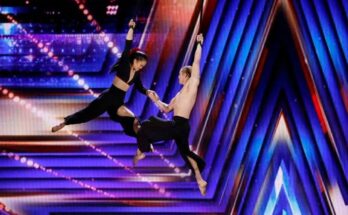
When Light Sketch Duo walked backstage for their fictional America’s Got Talent audition, they carried something most contestants didn’t need to worry about:
A very large collection of batteries.
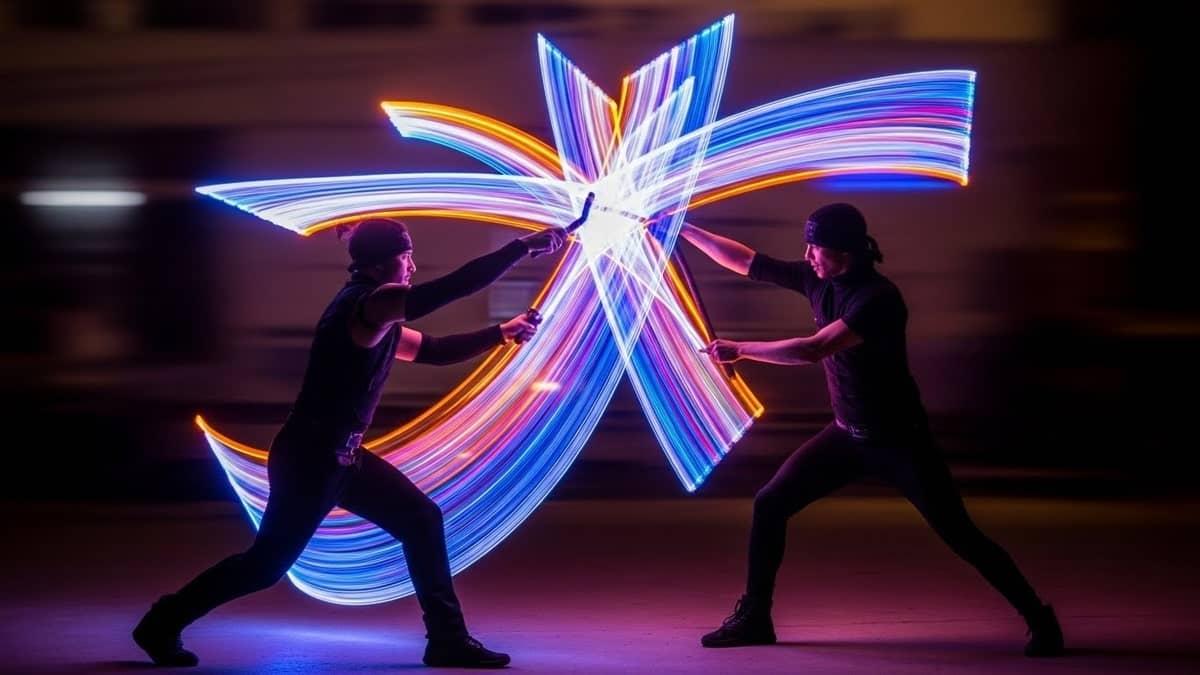
The fictional performers, Maya and Leo Hart, had built their act around light painting, using programmable light props to “draw” shapes through the darkness while synchronized projections transformed their movements into images.
Onstage, the result looked almost magical.
Backstage, however, it was significantly less glamorous.
There were tangled cables.
Missing batteries.
A mysterious flashlight that nobody remembered packing.
One costume that reflected entirely too much light.
And a dramatic argument over whether a power bank was “fully charged” or “emotionally charged.”
By the time the two performers reached the stage, they had already experienced enough backstage comedy for a television episode.
Then the lights went out.
And everything changed.

An Act Built From Light
Light Sketch Duo’s fictional story began with a simple idea: what if drawing didn’t require a pencil?
Maya had a background in dance.
Leo had experience with digital design and visual effects.
The two began experimenting with LED light props in a small rehearsal studio.
At first, the results were messy.
They attempted to draw circles.
The circles looked like potatoes.
They tried drawing stars.
The stars looked like exploding spiders.
They laughed and tried again.
Eventually, the movements became more precise.
The two performers learned how to coordinate their bodies, lights and timing to create recognizable shapes in darkness.
Real-world light-art performances use similar ideas. Some live light-painting shows translate performers’ movements into drawings and effects in real time, while others use LED props to create luminous trails and shapes.
From Messy Rehearsal to Television Stage
The fictional duo’s first performances took place in small community theaters.
The stage was usually dark.
The audience sat quietly.
Then small lights appeared.
A line became a circle.
A circle became a flower.
A flower transformed into a bird.
The reaction was immediate.
People weren’t simply watching dancers.
They were watching images appear in front of them.
Eventually, Light Sketch Duo decided to audition for AGT.
That decision created an entirely new problem:
How do you move a complicated light-based performance into a television studio?
Audition Morning
Light Sketch Duo arrived early.
Very early.
Their equipment cases contained rechargeable batteries, light props, backup controllers, cables, chargers and emergency replacements.
The duo’s fictional stage manager handed them a checklist.
Maya counted.
One.
Two.
Three.
Then looked confused.
“Where’s number four?”
Leo checked the list.
“That’s the backup.”
“Why isn’t it labeled?”
“Because it’s the backup.”
“That doesn’t explain anything.”
They laughed.
The day had begun.
The Great Battery Panic
About an hour before rehearsal, one of the performers announced:
“We have a battery problem.”
Everyone froze.
The production assistant looked alarmed.
“What kind of problem?”
Leo held up a battery pack.
“I don’t know whether it’s charged.”
Maya stared at him.
“Did you check?”
“No.”
“Why not?”
“I was hoping it would tell me.”
It did not.
Eventually, the battery was plugged into a charger and found to be nearly full.
Crisis avoided.
The duo agreed on one new rule:
Never perform technology-related magic without checking the technology first.
The Flashlight Mystery
Then a flashlight disappeared.
This was especially funny because Light Sketch Duo literally worked with light.
They searched the equipment cases.
Under chairs.
Inside backpacks.
Behind the stage.
Nothing.
Finally, Maya discovered the flashlight clipped to her belt.
She stared at it.
Leo laughed.
“You’ve been carrying it.”
“I was testing you.”
“No, you weren’t.”
Everyone laughed again.
Sound and Lighting Rehearsal
Light-based performances depend heavily on the environment.
The theater must be dark enough for the lights to stand out.
The lighting team has to carefully control background illumination.
The performers need to know where every camera is.
And if projections are involved, the timing has to be exact.
Real light-painting performances can combine live movement with projections and custom software, creating drawings that appear in response to the performers’ movements.
For Light Sketch Duo, this meant hours of technical preparation.
Rehearsing in Darkness
The duo’s rehearsal was unusual.
Most performers need light to practice.
Light Sketch Duo needed darkness.
The stage went black.
Maya raised her light wand.
A bright blue line appeared.
Leo moved beside her.
A second line followed.
Together, they created a circle.
Then another.
The choreography looked beautiful.
Until Maya went slightly too far left.
The entire picture became a strange glowing oval.
Leo stopped.
“That is not the moon.”
Maya laughed.
“Maybe it’s modern art.”
The Costume Problem
The duo’s costumes were designed to disappear against a dark background.
That meant the performers wore dark clothing with reflective details that could be illuminated when needed.
Unfortunately, one jacket reflected too much.
The wardrobe team noticed immediately.
Under normal lighting, it looked perfect.
Under the performance lighting, it looked like a road sign.
Maya stared at the jacket.
Leo laughed.
“You’re glowing before we even start.”
The wardrobe team swapped the jacket.
Problem solved.
The Final Rehearsal
Once all the technical details were ready, the duo performed their complete rehearsal.
The stage went dark.
The music started.
Blue lights appeared.
The performers moved.
A circle formed.
Then it became a butterfly.
The butterfly flew across the projection screen.
It transformed into a city skyline.
Then a giant glowing heart appeared.
Everyone backstage became quiet.
The act was finally working exactly as planned.
Walking Onto the Stage
When Light Sketch Duo’s fictional name was announced, the audience applauded.
Maya and Leo walked onto the stage.
They smiled.
Then the lights went completely dark.
For a few seconds, the audience couldn’t see anything.
Then a single point of light appeared.
The First Drawing
Maya moved her light through the darkness.
A blue line appeared on the screen.
Leo joined.
The two lines crossed.
They formed a circle.
The circle became a glowing moon.
The audience gasped.
Then a second light appeared.
A tiny white bird emerged.
It seemed to fly from Maya’s hand.
The audience applauded.
The Light Starts Dancing
The music became more energetic.
The performers moved faster.
Their light trails became longer.
Red.
Blue.
Gold.
Purple.
They drew shapes across the darkness.
A tree.
A bird.
A dancer.
A city.
Then an enormous star.
The visuals changed almost instantly.
The Surprise
The duo’s most ambitious moment came when the two lights moved independently toward each other.
They crossed.
At the exact moment they touched, the projection transformed into a giant explosion of color.
The audience screamed.
The judges jumped.
Then the colors faded.
A glowing figure appeared on the screen.
It resembled the silhouette of a child reaching for a star.
The performance had suddenly become emotional.
The Story Behind the Light
The fictional performance told a simple story.
Two people searching for something.
They meet.
They create light together.
They discover that what they were looking for was hope.
The final image was a sunrise.
Warm gold light slowly spread across the screen.
The performers stood beneath it.
Then everything faded.
The Final Moment
Silence.
The last musical note disappeared.
Maya lowered her light.
Leo lowered his.
The audience sat still.
Then the theater erupted.
People stood.
The judges stood.
The applause grew louder.
Maya covered her mouth.
Leo looked at her.
They both smiled.
They knew the performance had worked.
The Golden Buzzer
Then one judge reached toward the Golden Buzzer.
The audience began screaming.
The button was pressed.
Gold confetti exploded from above.
Maya jumped.
Leo jumped.
The lights continued flashing.
A piece of confetti landed directly on one of the light controllers.
Another landed inside a case.
Maya started laughing.
Leo shouted:
“We finally have more lights!”
Everyone laughed.
Backstage Confetti Chaos
The duo quickly learned that Golden Buzzer confetti doesn’t mix particularly well with technical equipment.
They carefully checked the light props.
One had several pieces of gold paper stuck to it.
Another performer brushed confetti from a cable.
Maya found a piece inside her shoe.
Leo found three inside his jacket.
He shook his sleeve.
More fell out.
“I think we’re taking this home.”
Maya laughed.
“Definitely.”
The Family Celebration
Their fictional families rushed backstage.
There were hugs.
Tears.
Cheers.
One parent hugged Maya and then immediately asked:
“Did all the equipment survive?”
Maya laughed.
“Yes.”
Leo held up the light controller.
“Mostly.”
Everyone laughed again.
The Backstage Interview
During the interview, the host asked:
“What was it like creating an entire world with light?”
Maya answered:
“Beautiful.”
Leo added:
“Technically stressful.”
The host laughed.
Leo continued:
“But mostly beautiful.”
It was the perfect description of their day.
The Internet Discovers Light Sketch Duo
When the fictional audition aired, viewers quickly became fascinated.
Fans replayed the performance to understand how the images were created.
Some viewers focused on the choreography.
Others loved the emotional story.
Some simply wanted to know how the performers could make a bird appear to fly across the screen.
The duo’s mysterious style became their biggest strength.
The Real Challenge: Making Technology Invisible
For Light Sketch Duo, the greatest achievement was making the technology disappear.
The audience wasn’t supposed to think about batteries.
Or controllers.
Or software.
Or lighting cues.
They were supposed to see art.
That is one of the greatest challenges of technology-based performance.
The more complicated the system becomes backstage, the simpler the experience should feel onstage.
The People Behind the Show
The fictional performance also depended on a large production team.
Lighting designers created the darkness needed for the light art.
Camera operators captured both performers and projections.
Sound engineers synchronized music.
Stage managers coordinated cues.
Technical crew members checked every battery and controller.
Production assistants made sure nothing was accidentally unplugged.
Without them, the illusion would fall apart.
The Funny Part of High-Tech Entertainment
The irony was impossible to miss.
Light Sketch Duo had spent months learning how to manipulate technology.
Yet backstage, they were still two people losing flashlights and arguing over batteries.
That contrast made the duo especially charming.
Onstage, they looked like futuristic artists from another world.
Backstage, they were simply two friends asking:
“Who took the charger?”
Preparing for the Next Round
The Golden Buzzer moved Light Sketch Duo forward.
But it also created pressure.
Their next performance had to be different.
They couldn’t simply draw another butterfly.
So the duo began planning new visual stories.
Bigger images.
More complicated transitions.
New colors.
More audience interaction.
But they knew one thing:
The technology could never replace the story.
Why Light Sketch Duo Stood Out
Their fictional AGT audition offered something audiences hadn’t expected.
It was part dance.
Part technology.
Part drawing.
Part storytelling.
And completely visual.
The audience wasn’t just watching a performance.
They were watching images being created in real time.
That made the experience feel almost magical.
One Last Backstage Problem
After the Golden Buzzer celebration, the duo began packing their equipment.
Light props?
Packed.
Controllers?
Packed.
Batteries?
Packed.
Chargers?
Packed.
Costumes?
Packed.
Then Maya looked around.
“Where’s the flashlight?”
Leo stared at her.
They both laughed.
The missing flashlight was finally discovered in the same equipment case it had been sitting in all day.
Maya shook her head.
“We are never telling anyone about this.”
Leo smiled.
“Too late.”
A New Kind of AGT Magic
Light Sketch Duo’s fictional journey demonstrates why visual performance remains so powerful.
A simple beam of light can become a drawing.
A drawing can become a story.
A story can become an emotional moment.
And an emotional moment can turn into gold confetti.
Behind the scenes, however, the magic is built from very ordinary things:
Batteries.
Chargers.
Costumes.
Cables.
Rehearsals.
Mistakes.
Laughter.
And plenty of patience.
That’s what made Light Sketch Duo’s fictional Golden Buzzer moment so memorable.
They didn’t simply use light.
They turned light into a language.
And for a few unforgettable minutes, an ordinary television stage became a canvas where two performers could draw an entire world.
Then the lights came back on.
The magic disappeared.
And somebody backstage immediately asked the most important question of the night: